Sunday, July 31, 2022

Burlington MM in New Jersey

I am relooking at some of what I looked at before the yDNA match of our Elliott participants to Jeff Houghton.  Jeff's match has me looking at an area in England rather than an area near Philadelphia.  I decided to look at the passengers who came over in the Kent in 1677 to settle in Burlington.  I knew that the Kent sailed from London and I have looked at the names of those who are said to have made that voyage.  But when I relook at the sites I have viewed before, I get some additional information that is indeed of interest. 

From: https://www.geni.com/projects/Quakers-of-New-Jersey-Kent-Passengers-1677/291

It should be noted that many passengers alleged to have been aboard were from Yorkshire, Northamptonshire, and other northern counties. They probably loaded at a northern port, perhaps Hull or Liverpool, before the Kent arrived at London, which is why they do not appear in the London loadings.

Reference: Passengers and Ships Prior to 1684, Penn's Colony: Volume I by Walter Lee Sheppard, Jr., 1970.

 I have found that the book can be found at the Boyd County Library and will go there to view it in August.

And on the site:

http://genealogytrails.com/njer/burlington/early_settlement.html

I have found the following:

Early settlement of the county (Burlington, NJ)
In 1675, Fenwick sailed from London in the ship "Griffin," Robert Griffiths, master, with his family and a company of Friends, and after a pleasant passage landed near the old fort " Elseborg," and named it Salem. This was the first English ship that entered the Delaware with emigrants, and no others followed for nearly two years.

Among the purchasers of West Jersey lands were two companies, one of Friends in Yorkshire, the other of Friends in London. In 1677 commissioners were sent by the proprietors, with power to buy lands of the Indians, to inspect the rights of such Europeans as claimed property, and to order the lands laid out, and in general to administer the government. Of the commissioners, those for Yorkshire were Joseph Helmsley, William Emley, Robert Stacy, and Thomas Foulke

And

The Yorkshire purchasers chose from the Assunpink to the Rancocas, which was called the first tenth; and the London chose the second tenth, from Rancocas to Timber Creek. For mutual protection and assistance they agreed to build a town in company, and the present site of Burlington City was chosen.

As best as I can tell those from London would have land starting at Burlington and going south on the Delaware river while those from Yorkshire area would have land starting at Burlington and going north on the Delaware River.

Elliott family in England

 I keep starting a new post about my Elliott family before the move to these shores.  In the years when they lived almost certainly in the area shown on the below map ads Yorkshire, Derbyshire, Nottinghamshire.


Just a few months ago I was looking mostly at Elliott in the area far south of this area near Somerset and Bristol.  However, a DNA match to my Elliott yDNA participants with whom I have become buddies caused me to give that research totally up.  Jeffrey Houghton is the match.  He does not carry the Elliott surname, but he is a clear match to our line.  His line has been in the area that I am now looking at for MANY generations.  And so I have redirected my research.  The odd thing about our yDNA match is that our group carries the C Haplogroup.  This is not the typical haplogroup for men in Great Britain.  It is more prevalent in males who are found in asia.  

Wikipedia says:  It is the most frequently occurring branch of the wider Haplogroup C (M130). It is found mostly in Central Asia, Eastern Siberia and significant frequencies in parts of East Asia and Southeast Asia including some populations in the Caucasus, Middle East, South Asia, East Europe. 


This haplogroup clearly points out that our Elliott family line almost certainly is not connected to the Elliott line found in the border lands of Scotland and England as these families carry the haplogroup R which is more prevalent in Great Britain and area.  It was hard to give up this Romantic tradition and accept this is just not likely to be our history.  So now I am focusing on the area that is described above.  

At the same time I am reading a book that I LOVE! It is about the Vikings

https://serendipityreading.blogspot.com/2022/07/vikings-by-neil-oliver_19.html

Jeffrey wrote me an e-mail that I am reading today.  And it is one of those times when everything that I have been doing and thinking all come together.  Here is an excerpt from Jeffrey's e-mail:

Now the shock horror news of the Elliot's, they are bad, bad Vikings who came over with William and maybe a connection to the Britons of old.(Brittany for 500 years. ) Right history lessons and NOT Scottish by origin LOL

 And the truth is that this is not such a shock....it is what I had been reading about right now as well.  What a shock from my book that the Normans who invaded England in 1066 were actually Vikings who had lived in Normandy and intermarried there.  But that absolutely fits with what Jeffrey is telling me now.  And my gut feeling has been that indeed our C Haplogroup may have come to the area with the Romans and continued in the area in Briton population when the Romans pulled out.  But the actual Elliott name may have come in with the Norman invasion?  Lots to think about!

Next I want to add  a URL for a site that Jeffrey sent:

https://selectsurnames.com/elliott/

England.  Following the Norman Conquest, Elliots – sometimes as Alliots or Elyots – spread across eastern England, notably to Yorkshire, Lincolnshire and Cambridgeshire.  .....

Ok...not sure we'll ever get all of this figured out, but it sure if fun!  

Saturday, July 16, 2022

McGregor family

 I have two dna matches on Ancestry that were a VERY pleasant surprise for me.  Both carry surname of McGregor.  I never expected to have the luck to find anyone anyplace who descend from Robert and Mary Ann McGregor.  They were the original immigrants from Scotland and Ireland who arrived in New York before 1853.  

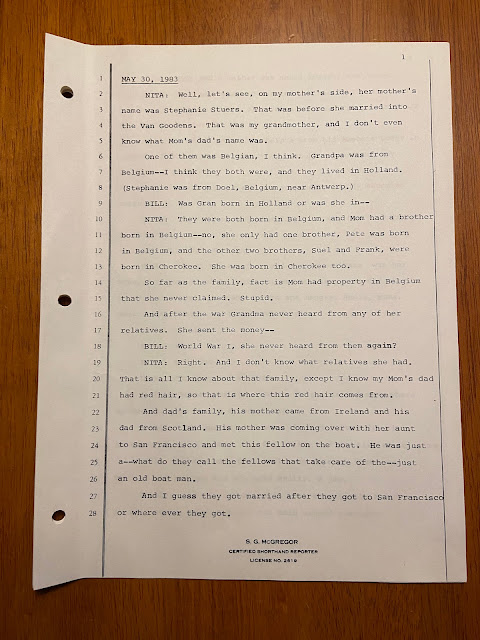
Katie McGregor has sent me some pages that are taken from an interview with Nita McGregor who would have been Katie's great aunt if I am figuring this correctly.  Katie had very nice things to say about Nita including the fact that she lived to near 100 years old.


Sorry I can not seem to find a size to use that is easy to read.  


Thursday, July 14, 2022

Wirksworth, England and the Elliott family

I am beginning to look at the Quaker and also the early Elliott family lines found in the area in which Jeff Houghton's Houghton line are also visible in the 1600s.  I have asked Jeff to help me with this project and this blog post will be where I jot down ideas and thoughts.  Jeff has mentioned Wirksworth, so I will start with that.  His comment was:


Been going through the Elliot's of Wirksworth and the earliest mention is of one that had one of the first rifles in Liz the 1st time (1500s) NO mention of Houghton before 1620, also noticed at a quick glance of the records that several of our line married Elliot's although far to late for our quest.  .....

The red marker on the below map shows location of Wirksworth in England.  It is in the County of Derbyshire.  This seems to be a good place to start.


 Who moved from this area to Pennsylvania c.1682?  One family was George and Hannah Wood with son-in-law, Richard Bonsall.  They moved with six other families from Derbyshire (not named by the author of this blog post) and settled in Darby, PA.  Darby is shown win the below map outlined in Red practically next door to what is now the Philadelphia International airport.


This family had roots in the Netherlands and had moved to Wirksworth for iron mining.  After becoming Quaker in Wirksworth, they decided to move to Pennsylvania by 1682.

Friday, July 8, 2022

Viking DNA

Living DNA sent an e-mail this week with the following photos and information:  


Absolutely!  I am fascinated with this idea1


And, of course, I did the upgrade!


Living DNA suggests that my results show that out of the entire population who has tested at their site, I have more Viking connections than 68% of those who have tested.  And that the Vikings that I seem to most match are those who fit this description:

While Norwegian and Danish Norsemen went westward, the Swedish explored eastwards into the Baltic sea. Here they found the estuaries of the rivers that lead inland across Eastern Europe into modern day Belarus, Russia and Ukraine, travelling along the Volga and Dnieper rivers until they reached the Black and Caspian Seas. On this journey these Vikings became known as "Rus" or "Varangians" by the Slavic people they encountered. Expanding partly through raiding, but mostly by trade, their influence grew. When they reached the Byzantine city of Constantinople on the Black Sea, it was raided in 860. In the aftermath of the raid, the Norsemen were accepted as trading partners by the Byzantines, an agreement which greatly increased the wealth and influence of the Varangians. The Varangians were here to stay.

In 862 Prince Rurik of the Varangians was invited to rule over the Slavic peoples to the south of the Baltic Sea. He founded his capital city of Norvgorod on the Volkhov river, and his descendant Oleg expanded their territory further into the south along the Dnieper river. Oleg eventually took control of Kiev in 882. It was from here that he decided to now rule, and continue to gain more territory. By 885 Oleg had united the majority of eastern slavic peoples under his rule and thus the country of Kievan Rus was born.


I found a good map and information about this at:

https://www.asncvikingage.com/vikings-east


The below map gives one an idea of how my ancestors living in Courland might have been well placed to have had Viking ancestors.  And in 2023 I have found an autosomal dna match who still lives in Finland.  I want to add some surnames here so that the search engine will find this blog post when I use surnames:  Beuhring, Danneburg, Konig, Koenig,  These are the surnames that my 2-gr-grandfather, Frederick Konig Danneburg Beuhring descended from and his parents chose to add them to his name.


In 2026 I have found another ancestor who may have given me Viking DNA: Jacob Castle.   I have been looking at the yDNA of my ancestor, Jacob Castle.  I paid for a participant who also descends from Jacob Castle to take the BigY and his matches have names that are absolutely Scandinavian.  I need to see if I can figure out if they are Swedish, Norwegian, or Danish.....Could Jacob have ancestors who were Viking but have descendant who are living in German by late 1600s and early 1700s but still carry Viking DNA?  Below is a map of the German rivers.


 Jacob Castle is an enigma but clearly his descendants today match men who are still living in the Scandinavian countries. 

AI found for me the following article:

Wednesday, May 25, 2022

Elliott family line in England

 Yesterday, FTDNA sent me an e-mail that there were new matches to Roland and Gerald Elliott.  I bought both 37 marker tests this past year and the match was to both men.  Here are parts of  the answer that I received when I reached out to the new match with geography added:

Yesterday, my prayers were answered with the connect to Sir Thomas Elliott line, and obviously yours at some time, when a Hoghton of Hoghton tower it seems started a cadet house in Yorkshire, and married an Elliott, and within two generations or so are in Nottinghamshire, and now close the link to our years in Derbyshire starting around the time of our Civil war.


Yorkshire is a historic county in northern England. It’s known for its Roman and Viking heritage, as well as its Norman castles, medieval abbeys, Industrial Revolution-era cities and 2 national parks. The county town of York, founded by the Romans, is home to 13th-century cathedral York Minster, Tudor houses and medieval walls. The interactive Jorvik Viking Centre recalls the area’s 9th-century Norse occupation.

Yorkshire


From Albion's Seed by David Hackett Fischer: (page 438)

"The Quaker founders of Pennsylvania and West Jersey came from every part of England.  But one region stood out above the rest.  The Friends' migration drew heavily upon the North Midlands, and especially the counties of Cheshire, Lancaster, Yorkshire, Derbyshire and Nottinghamshire.  In a list of English immigrants who arrived at Philadelphia between the years 1682 and 1687, more than 80 percent came from these five contiguous counties."

and

"On both banks of the Delaware River, these Quaker immigrants distributed themselves in small settlements according to their places of origin in Britain.  Country Quakers from Cheshire, Lancashire and Yorkshire settled mainly in Chester and Bucks Counties.  "the farmers amoung them poverty stricken dalesmen from the moors of northern England." writes Frederick Tolles, "headed straight for the rich uplands of Bucks and Chester"  The lands around Trenton were occupied by emigrants from the Peak District of Derbyshire and Nottinghamshire.  London Quakers preferred the city and county of Philadelphia.  Emigrants from Bristol founded a town of the same name on the Delaware River.  Dublin Quakers occupied  Newton, West Jersey.  Emigrants from, Wales colonized the "Welsh Tract" west of the Schuylkill River"

Just to make this easier to think about here are the boundaries of the original three counties:


So we have Bucks, Philadelphia, and then Chester which stretched as far west as anyone would want to go.

Lancaster was carved out of Chester in 1729.  It is the area that is west of the other three counties.  It was growing exponentially by this time.  No one was settling yet on the other side of the Susquehanna River.  The Indians considered it their land at this time.


I am reading Albion's Seed and adding to this blog post as I have time.

In July, I am adding again to this blog post that was interrupted by Mary's wedding and my having finally caught Covid.  This next excerpt is from The Beginnings of Quakerism on page 42:

I am reading this on google books.


"We now turn to the small beginnings of this Quaker Movement.....In a document written in 1676, Fox says that the Truth sprang up first in Leicestershire in 1644, in Warwickshire in 1645,  in Nottinghamshire in 1646, in Derbyshire in 1647, and in the adjacent counties in 1648, 1649, and 1650.

This is from George Fox Epistles p 2.

In another paper he speaks of business meetings concerning the poor.....held earlier than 1650 in Nottinghamshire, Derbyshire, and Leicester, where there was a great convincement.


Sunday, April 10, 2022

Handley family

 In preparation for my conference and genealogy jaunt the first week in May, I am looking at my Handley family.  I believe it quite likely that they are Scotch Irish.  I would like to look at Pennsylvania Records on this trip.  What do I know so far? 

The internet suggests that John Handley moved his family to the very Scotch-Irish area of Augusta County, Virginia around 1750.  At the time of his move, Augusta County was everything west of the Blue Ridge Mountains in Virginia.  The area had been Orange County starting in 1734.  But in 1738 Augusta County was formed and Orange County became small while Augusta County was everything to the west.  However it was not until 1745 that Augusta County was organized.  


And the Chronicles of the Scotch Irish in Virginia by Chalkley do bear out the settlement of John Handley.
I have found a paper written about the family at:


and from that paper I add the following:

John Handley's name first appeared in the official records of Augusta County, Virginia, on November 26, 1751, this was the date of the deed in which he purchased 257 acres from Benjamin Borden for 15 pounds. The land was located on the Broad Spring Run (Back Creek) adjoining land of Joseph Kennedy (Northern area of present Rockbridge County, Virginia)


the Borden Grant was located south of Beverley Manor
Source: Library of Congress, Carte de la Virginie et du Maryland (1757)

In 1739, the colonial government authorized a 100,000 acre grant to Benjamin Borden. The land to be selected and surveyed was to be located south of William Beverly's grant, and would be clearly out of the area claimed by Lord Fairfax.

Borden was required to recruit 100 settlers within two years. He succeeded, and patented 92,100 acres. So many settlers were Scotch-Irish that the area became known as the "Irish Tract."1

The land was within the planned boundaries of Augusta County. The General Assembly chartered Augusta and Frederick counties, the first two completely west of the Blue Ridge, in 1738. The county courts were not appointed until there was a critical mass of settlers in 1743 (Frederick) and 1745 (Augusta). During Borden's two-year settlement period, Orange County had the only county surveyor west of the Blue Ridge. 

From Chalkley:

Page 114:  Commission for examination of Grissell, wife of John Handley

Page 137:  Wm. Christian, John Handley, James McKain, John Archer, Zachh. Johnston and John Hunter--certificates of hemp

Page 320:  Thomas Thompson vs. John and William Handley--John Handley and William Handley of West Nantmill Township, and County of Chester, weavers.  Augusta 1758

Page 437:  Petition for road from Joseph Kennedy's Mill to John Huston's, and from John Huston's to the great road from Timber Grove to Woods Gap: James Hill. Joseph Kennedy, John Wilson, James Eakin, John Handley, William Wardlaw, William Lockridge, John Edenston, William McConnell, Walter Eakin, Robert Stewart, Robert Dunlap, Andrew  Duncan, John Huston, Samuel Huston, Robert Alexander, Patrick Hays, John Montgomery,. Andrew Steel, John Stewart 1751-1752

This piece of information from Chawkley gives us what we need to know to find the land of John Handley.  On a site on werelate:

https://www.werelate.org/wiki/Person:Joseph_Kennedy_(17)

You can see the land of John Handley next door to the land of Joseph Kennedy. #257 , 1751.  Look between the two purple lines about two plots east of the top arrowhead on Broad Spring Run

I have spent the evening trying to ascertain where John Handley and Joseph Kennedy's land was on a modern map.  I think I have figured it out.  You will need to manipulate the below map in order to see where the men lived.


If you have no luck, contact me at mosesm@earthlink.net and I'll send you a copy via e-mail.  But basically what the above map shows us is that the land on which these men lived would have been quite close to the New Providence Presbyterian Church.  The church that is in existence today is said to have been where today's church is located,.  The land was given by Joseph Kennedy and his wife.  On this close-up map you can see Moffat Creek.  And interestingly enough there is a Hays Creek.  John Handley's wife, Grissell had grandmother with maiden name Hay.

Here is the location on a map that shows more of the area:


I feel as if we now have a feeling where John Handley and his family lived in the mid 1799s.

How do I know that this is the right location?  From Chawkley:

  • Page 331.--21st August, 1754. Joseph Kennedy (his mark), Gent., and Elizabeth, to Samuel Buchanan, James Walker, Robert Reagh, John Logan, Alexander Miller and William Kennedy, trustees appointed and chosen by the Presbyterian Congregation of New Providence in Augusta County for and on behalf of themselves and the rest of the said Congregation and their successors adherents to the Squad of New York of the other part. Consideration: The sincere regard, good will and affectionate love which he beareth unto the said Congregation, and with an eye to encourage the worshipers of the most Blessed and Glorious Trinity, the Father, Son and Holy Spirit, who is God over all, and Blessed forever, Amen; and for and in consideration of the sum of six pence sterling; for public use and benefit of the said Congregation for a Presbyterian Meeting House to worship Almighty God in and for a burying place and graveyard to them and such as shall hereafter joyn with them the said Congregation of New Providence a certain moiety piece or parcel of land whereon the said Congregation hath already began to prepare and build a meeting house containing 3 A., 1 R., 27 P., on west side Moffet's Creek in Borden's tract; said Kennedy's and Francis McCown's line being a line of land now in possession of Andrew Duncan. Delivered to Samuel Buchanan, 21st June, 1758.
And I also find evidence of Joseph and his wife having given land on the website of the church in their history.

Further proof that these people were friends and neighbors is found in Chawkley:

  • Page 339.--20th May, 1760. Joseph ( ) Kennedy to John Handley, Jr., £80, 300 acres in Beverley Manor, above. Delivered: Jno. Handly, 1766.


Margaret Handley was the wife of William Clendenin. Margaret was born in 1762 and died in 1835.  Margaret would have been around 11 years old when the family made the move south.  


William Clendenin was born in 1753.  They were married in 1783.  All of these dates are only guides...perhaps even iffy.  But the fact that this couple were married is proven by a deed of gift in Greenbrier County.


Greenbrier County, VA Deed book 3, page 248.


Know all men by these presents that I John Handley Senr. of the County of Greenbrier and State of Virginia for an in consideration of the love and natural affection which I bear to my daughter, Margaret Clendinen, consort William Clendinen of Mason County and state aforesaid as well as for the further consideration of one dollar .... have given and granted and by these presents do give and grant unto the said Margaret Clendinen ... one negro girl known by the name of Abbey of the age of eight years ...


Signed by John Handley Senr. Witnessed by Jn Mathews, Thomas Creigh, C. Welch, Charles B. Robins


 I found confirmation of this deed in a book on my shelf entitled Greenbrier County Deed and Will Records.  My William Clendenin is well proven so this is how the Handley family fits into my tree.  At the same time I found confirmation that John Handley was giving gifts to other daughters:  Grisey Cailes, Sally Scott of Rockbridge County, Elizabeth Morrow wife of William Morrow.  This is found on pages 95-96 of my book.


So where were they living?


I get a clue of where he lived by a story in the History of Greenbrier County by Otis K Rice.  On pages 186-188 of his book he talks about the Rev John McElhenney.  It is a good story and worth reading.  But what is relevant to today's story is that in 1807 as Reev McElhenney finished what is now Washington and Lee University, The Presbytery of Lexington sent him on a one-month missionary visit to Greenbrier County.  Stopping along the way to preach his first sermon west of the Alleghenies at the residence of William Haynes at Gap Mills, Monrow County, and other sermons at the homes of William Hamilton on Muddy Creek, Andrew McClung on Sinking Creek, and John Handley on Spring Creek.


If you look on the below map and start at Lewisburg and go up the valley on route 219 towards Renick,
I believe Spring Creek to be between 219 and the Greenbrier river which is the dark on this map flowing down from Renick.  Renick lies on the Greenbrier river.  But I can say that I feel very sure that if you draw a circle around Renick that intercepts with 219, the Handley land would lie in the circle below Renick.


Ok.  The Handley family is no longer living on the property that John Handley had bought from Benjamin Borden.  I am almost positive that I remember reading that John Handley had sold his land on the Borden grant to a man with surname Kennedy and that when I was looking at that sale, I was thinking that one of the Campbell girls had married a Kennedy.  I will try to fill this in in the next few days.