Monday, May 28, 2012

Hawkins in the Northern Neck

While working on an article for Phil Hawkins' Hawkins DNA Newsletter for the month of May, I found myself talking about the ancestry of my dad's closest DNA match, Gene Hawkins.  Here is what I sent to Phil for his newsletter:


The month of May held a very special event for me!  I visited Gene Hawkins in Warren County, Ohio.  Gene is my dad's closest DNA match.  The celebration took place over dinner at the Golden Lamb with Gene's wife and several of his family and friends.  It was a VERY special evening!  I was in Cincinnati for the National Genealogical Society's Annual Conference only a 35 minute from Warren County.  Gene and I do not yet know who our common Hawkins ancestor will prove to be.  Gene connects to James and Jane Bourne Hawkins who were married in Culpeper, Virginia probably 12 April, 1781.  This couple moved to Kentucky after the Revolutionary War where James Hawkins died 2 Mar 1819 in Anderson County, Kentucky.  
James was the son of Benjamin and Sarah Willis Hawkins.  Benjamin Hawkins died c.1782 in Culpeper County, Va.  My Hawkins line has earliest ancestor, Thomas R. Hawkins who was born c. 1797 in the same general area of Virginia as Gene's early ancestors.  Thomas R. Hawkins lived most of his life in Orange County, Virginia which adjoins Culpeper.  He married Matilda Pinkard in Culpeper County in 1823.  

I believe that it is almost a certainty that Gene and I will find common ancestors in the Northern Neck of Virginia one, two, or three generations before what we know now. Perhaps our connection will be as early as the 17th Century.  Other researchers have told me that Benjamin Hawkins who married Sarah Willis had father, John Hawkins who died bef 1716 in Richmond County, Virginia (a part of the Northern Neck of Virginia).  The below information may or may not relate to Hawkins DNA group #1.  I am mostly brainstorming to see if anyone in DNA group #1 or any other Hawkins DNA group recognizes anyone or anything that might be a clue for all of us.


I found myself wanting to explain a bit about the Northern Neck and Hawkins connections to that area and decided to do that in a new Blog article.  In its most common definition today the Northern Neck consists of the four counties between the Rappahannock and Potomac River, which are Northumberland, Lancaster, Richmond and Westmoreland Counties.


However, for genealogical purposes, we might not want to be so narrow in our looking at the area.  So I am going to include Essex County in my information on this Blog which is just south of the Rappahanock River.  In these very early years Rivers were used for transportation and a neighbor who lived just across the river might be closer in proximity than someone who lived in a place that would have had to be reached via land roads.


You can see where Gene's possible ancestor, John Hawkins,  is said to have died in Richmond County.

Other early Hawkins men that I have looked at are Thomas Hawkins who I call Thomas of Old Rappahanock County.  Since my earliest proven Hawkins ancestor  is Thomas R. Hawkins, you can guess why I might like to look at early men named Thomas Hawkins.  This Thomas Hawkins died in Rappahanock County, Virginia in 1677.

The County of Rappahanock disappeared in 1692.  The part of the County that was north of the Rappahanock River became Richmond County.  The part that was south of the river became Essex County.

There is also a well documented Hawkins family that I call the John and Mary Long family.  It is doubtful that Mary actually had Long as a maiden name.  However,  Hawkins researchers called John's wife Mary Long for so many years that everyone immediately recognizes the family by this title.  This family seems to be found in Spotsylvania County in 1740 when John died.  Other researchers have told me that John migrated to these shores sometime between 1705 and 1720 and settled first in St. Anne's Parish in Essex County, Virginia.  He bought land in Spotsylvania County from Thomas and Larkin Chew 1723-1725.  He is said to have moved to Virginia with his brother, Philemon Hawkins.  This is idea is reinforced by the fact that he named a son Philemon.  Others say that both John and Philemon and their families lived first near Todd's Bridge over the Matapony River in what was then King and Queen County.  If you start at Tappahannock on the Rappahanock River in Essex County on the map below and travel in your mind south on Rt 340 to the Mataponi River, it crosses about the site of Todd's Bridge according to the research that I have done thus far.  If you have trouble seeing the below map, try single clicking on it to get a better view.


Thursday, May 3, 2012

Eno families of NC and their relationship with my Moore Family in NC


In this Blog entry, I will look at the families that are named on the back of the Eno Cemetery Stone marker.  For more information about Eno Cemetery, see my Blog entry dated April 24, 2012.

I already talked about the Maddock family in the same April 24, 2012 blog entry.

I am reading Joseph Moore's article that was published in the Georgia Genealogical Society Quarterly, Vol. 44, No 1 that was titled:  The Quaker John Moore of Upton's Creek, Wrightsboro Township.
On page 15, he says that the Moore family (Richard and Sarah (Jenkins?) Moore) were following their daughter Mary and her husband Joseph Mooney Sr. who  had made the trip to Orange County from Pennsyvlania by 1 March 1755, when Joseph Mooney was received in membership at Cane Creek Meeting.  The Mooneys had been members of Maiden Creek and New Garden Meetings in Berks County.  Remember that the Eno was a preparatory meeting for at least some of the years that these families lived in the area of Cane Creek MM.  I need to do a bit more research in order to be sure that the Mooney family mentioned on the stone is the same Mooney family that is daughter and son-in-law of John Moore.

Sarah Moore McKinsey--wife of George McKinsey


Today's entry is about George McKinsey and his wife, Sarah Moore.  It is also about the serendipity of the internet.  And the fortunate discoveries that networking can provide.

In 1998 my husband and I were preparing for a trip to Scotland with three other couples.  The men were a foursome who would play golf on as many of the famous golf courses of Scotland as they could arrange in the time period that we would be traveling.  I was trying to do as much research as possible to get ready to sightsee while the men played golf. 

The obvious choices for my research were my father's mother's people.  My grandmother's maiden name was McGregor and her mother's maiden name was McKinsey.  I knew the romantic story that was told in the family that Robert McGregor was a ship's captain who was transporting Irish passengers in the mid 1800's when he fell in love with Mary Ann Hare/O'Haire.  He married her and their first son was born in New York.  Robert then traveled to California and sent for his wife and son to join him. I descend from a later child, James McGregor, who was born while the family lived in Cherokee, CA.  

On the McKinsey side I knew very little.  But with help via internet from Tim Purdy of Susanville, CA,  I was able to discover that my grandmother's gr-grandfather's name was Andrew Jackson McKinsey and that he had moved to CA during the gold rush.  But I will save that story for another entry.

That year I was "hanging out" at my local LDS FHL and I somehow stumbled onto a fiche that I ordered that was a filming of a book by Ruby Mundell Barry:


The McKinsey's, McKensey, McKensie, McKinsey family : descendants of George K. McKinsey and his wife Sarah (Thomas) McKinsey of Newberry County, South Carolina, and Warren County, Ohio, and the migrations of their children into Indiana (fiche #6049761)


I printed out much of the book and it became my Bible on the McKinsey family for the next ten years.  My grandmother would have been amazed to find out that on her mother's side her family had been on our continent since before the Revolutionary War.  It is hard to believe that only 15 years ago I did not know these people.  I have had so much fun looking at the descendants of George and Sarah!

A new highlight in my McKinsey research was just a few years ago when Harriet Imrey who is my good friend via internet pointed out that George had been a loyalist in the Revolutionary War.  That was part of what started me on my quest to understand the Revolutionary War in the south that has been my passion ever since.  And that is a subject for another blog as well.

But back to my story.  I spent the next ten years after discovering George and Sarah McKinsey in SC looking at the Thomas family trying to figure out how Sarah was related and who of the Thomas family that were in NC and SC might have been her father.  I just couldn't seem to make her fit in.  Now, I don't want you to think that I am so dumb that it took me an entire ten years to make a breakthrough on a line.  I need to explain that I do many lines all at the same time. I am just as interested in the female lines as I am in the male lines.  Thus when I take a family back one generation, I have two lines to research:  that of the mother and that of the father of the ancestor at which  I am looking.   I am always researching ALL of my lines.  So I just chip away.

Why did Ruby Mundell Barry think that Sarah McKinsey's maiden name was Thomas?  Because of a will that she found that had been written by Nehemiah Thomas.  The transcription below of this will can be found:  


From the evidence in the will, Ms. Barry had assumed that Sarah was the niece of Nehemiah Thomas.  However, I am now totally convinced that Sarah was the niece of Abigail Moore Thomas instead of Abigail's husband, Nehemiah.  That is that Sarah was a Moore NOT a Thomas as Ruby Mundell Barry had assumed.  I will save my arguments as to why I have adopted this Moore family as my own for another post dated Sept 1, 2012.

Tuesday, May 1, 2012

George McKinsey's second wife


Joseph Moore sent me a scan from a book compiled by Majorie Dickey Parsons called:  Lines and Lifestyles Dickey, Moore, Parsons and some Related Families.  My understanding of the people who are named on this page is so new and so exciting that I found myself wanting to record how it happened.  According to the notation on the front cover, Ms. Parsons is no longer alive.  Below is page 222 of Ms. Parsons' book.

Only a few years ago, I would have had no clue that Daughter Mary m. George McKinzie "in Ohio" who is listed in the above transcription of the will of John Moore was the second wife of my 5-gr-grandfather.  George was not the simple farmer that I would have believed him to be.  After the death of his first wife, Sarah Moore, George moved his entire family to Warren County, Ohio with the mass exodus of the Quaker families out of the south and into the non-slave northern states of Ohio and Indiana.  Then after getting his family settled in Ohio, he traveled back down to Newberry County, SC to finish some business and then down to Wrightsboro, Ga to marry a cousin to his first wife:  Mary Moore Lacy.  Next he proceeded to move all of her family up to Ohio.  It must have been a huge undertaking!


Tuesday, April 24, 2012

Eno Cemetery Marker Dedication

Eno Cemetery Marker Dedication just North of Hillsborough, NC April 22, 2012

I suspect that my Moore ancestors may have been affiliated in some way with the people who were a part of the Preparatory Meeting at Eno.  I have not yet done the research to back this "gut feeling" up with lots of documentation.  I do know that Richard and Sarah (Perkins) Moore lived in this area with their children between 1757 when they presented a certificate from Exeter MM in Berks County, Pa and were received by Cane Creek MM and 1767 when they were granted certificates to Fredericksburg MM in SC.   I will begin a separate blog entry on the families who are named on the back of the below stone marker in relationship to my Moore family in an entry dated May 3 and named:  Eno families and relationship with my Moore family.

 Richard and Sarah's son, Mordecai, was dismissed from Cane Creek MM in 1758 for marrying out of unity.  His wife was Mary Lackey who was the daughter of Alexander and Elizabeth Maynard Lackey.  Richard and Sarah's daughter, Abigail, also married out of unity while the family lived in the area near Hillsborough.  She was dismissed for marrying out of unity in 1766  when she married Nehemiah Thomas.  Daughter, Prudence, was also dismissed for marrying out of unity in 1759.  Prudence is named as Prudence Ryan in the will of her father, Richard Moore.  

I have found on the below photos, that if you double click, the result is a much better image to view.  The maps are very hard to read until one uses the double click to bring them into better view.


This is the new Marker that was being dedicated.  I believe that the stone walls are probably part of the original Eno cemetery.


This is the back of the marker taken from inside the cemetery.


Jeff Palmer reminded me that the following URL has more information about the cemetery and who is buried there:

This shows the location of Eno Cemetery (Red flag in upper right hand corner) just beyond the Mars Hill Baptist Church
on Rt 57 North of Hillsboro, NC.

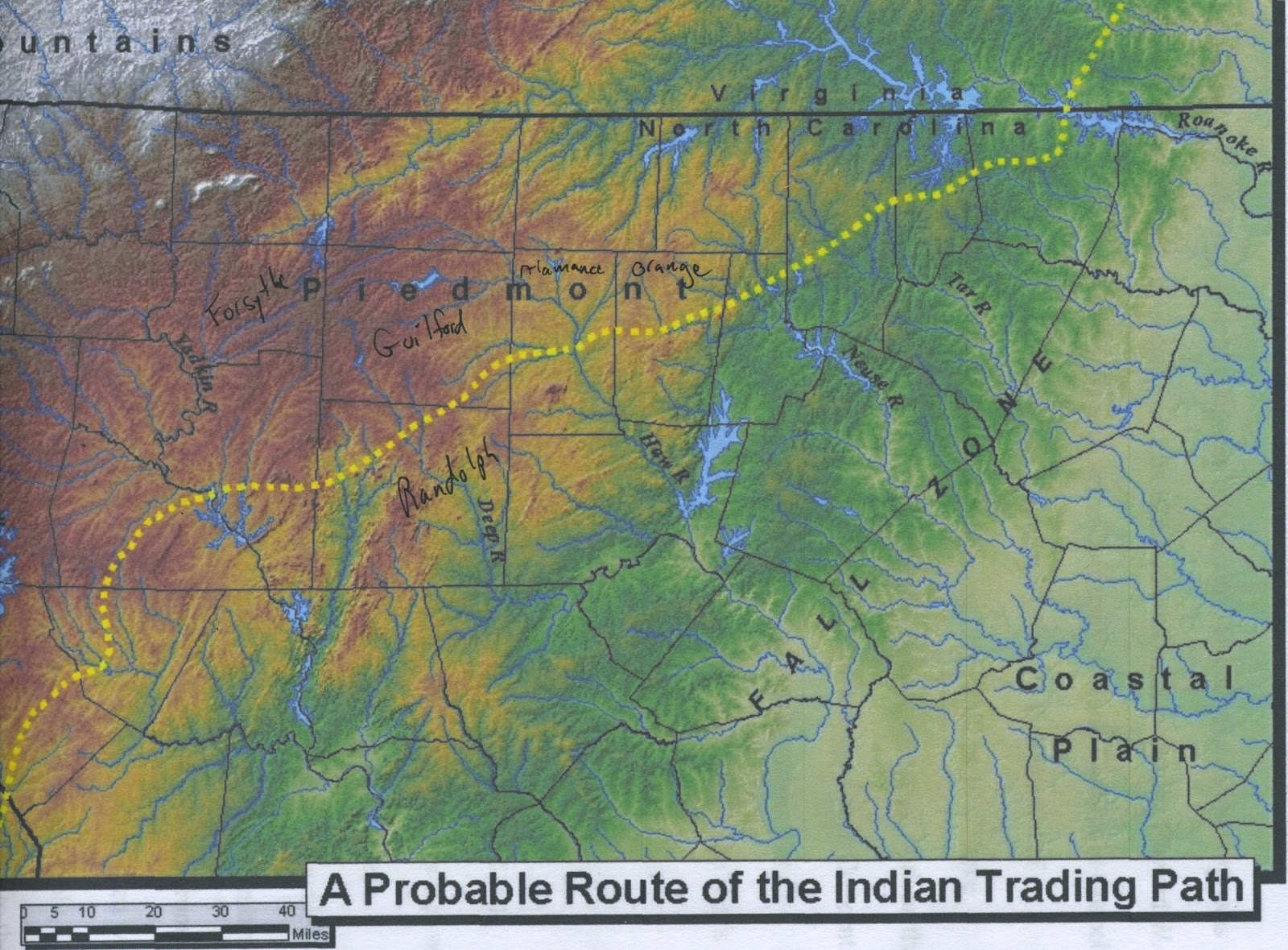
Of great interest to me at the meeting was the fact that the original land that was deeded from Joseph Maddock in 1756 to the Quaker families to use as a meeting place and for the cemetery lies on the Great Road.  It is stated in the deed that it "runs along the great road".  It is understood that this would have been the Indian Trading Path.  This would have been valuable property since it lay along a principal navigation route.  


above map taken from dissertation by Gladys Rebecca Dobbs found on line at http://www.unc.edu/~grdobbs/dismaps/dobbs2006disfinalpdf

This map gives one a feeling for the distance from Hillsborough and surroundings to the Cane Creek Monthly Meeting which is designated Quakers Meeting H. on the map just below Cain Creek Mountain
I took this version of Mouzon's Map from a website on the Creek family who lived here:
http://www.moonzstuff.com/cheek/robert1730_oforange_p5.html#map
The author of the above website has a great list of historical maps on his website at:

My Moore family had moved to Wrightsboro, Ga from the area near Eno before the Battle of Alamance took place in 1771.  In trying to explain why they moved I need to put together miscellaneous ideas that I will just add below and try to organize at a later time.  But it will be very clear that they were involved with some of the families named on the stone above.  

Jimmy Carter in his book The Hornet's Nest says the following about Joseph Maddock on page 45 of his paperback version:  " The acknowledged leader of the Friends was a man named Joseph Maddock, who operated a gristmill on a creek....All families in the area carried their grain to Maddock's Mill, knowing him to be an honest man--a rare thing for a miller--whose toll was always what he promised it to be.  As did other Quakers, he posted his fees for the various services he offered and considered it a violation of truth to bargain or to modify these charges for a particular customer.  Any busy farmer in the area who wanted to continue working at home could send a young boy or slave to the mill and be sure he would get back the right amount of flour, meal, or grits, ground the way he had ordered it.  Although silence often prevailed in the regular religious meetings, Maddock liked to talk, so it was natural that most farmers preferred to carry their own grain to the mill and catch up on the local news."

For nearly 13 years Maddock's Mill was the nearest grist mill to the county seat of Hillsboro. In October, 1766, however, Maddock's name and his mill became publicly linked with the Regulators,5 and from that time forward he feared that the mill and his entire North Carolina property would be confiscated by Governor William Tryon.6 The alarmed Maddock and other Eno Quakers swiftly entered for new lands in eastern Georgia;7 and in November, 1767, according to the old Registration of Deeds Book in Raleigh, Maddock conveyed his 20-acre mill seat to Governor Tryon's friend, Capt. Thomas Hart,8 and in July, 1768, he conveyed a 434-acre tract, a sizable portion of his plantation, to Governor Tryon himself.9 Whether or not these two conveyances- were actual sales or thinly disguised confiscations, one cannot say. In any event, by deeds and State land grant, Maddock's lands came into Thomas Hart's hands and Hartford Plantation came into existence.10 

Captain Hart (1730-1808) was a Virginian from Hanover County, an adventurer," one of "the men with silver buckles on their shoes" who invariably married heiresses and gradually pushed the less sophisticated pioneer Quakers out of their little stores and inns and acquired their mills and farmsteads – a pattern of polite, ruthless aggression in the Eno River Valley entirely fascinating and chilling to trace today from our vantage point in time.12
 (http://www.enoriver.org/eno/Shop/Journals/MillJournal/hartfordmill.htm)


According to a list compiled by Pearl Baker for Story of Wrightsboro, Richard Moore owned lot #46 and #42, and his sons owned:  Mordecai Moore  lot #7, Thomas Moore #72, John Moore #5.  Mordecai also owned acreage outside of town (as many others did): 300 acres on Upton's Creek. It is clear from the date on the certificate from Cane Creek to Fredericksburg MM that the Moore family was firmly established in the Wrightsboro community with the first Quaker group to move from NC to GA.  The below maps show where the Moore family would have lived in this time period.


I will be editing this site with more information as time permits.  If you have interest in this subject, please bookmark and return to see if I have added anything of interest for you.  I hope to include information about family members who moved to the Bush River (Newberry County, SC) area as well as that of Wrightsboro.  Also please get in touch (mosesm@earthlink.net) if you have input or see something that I might edit.

Saturday, March 24, 2012

Mattie Lee Johnson was the best dancer in Henry County

The lady who is being talked about in the below story is Mattie Lee Johnson Harris.  She was born 29 Oct 1891 in Henry, Virginia in the County of Franklin.  Her parents were Robert Henry and Francis Ann Shelton Johnson.  It is Mattie Lee who is said to have been voted the best dancer in Henry County, Virginia.

I asked Granny to tell me the story about what a wonderful dancer her mother was before her marriage to Pop Harris.  Barbara, Granny and I were having dinner at Guyan.  I had the following note in my data base about Granny Harris:


Granny Harris always told her children she was raised at the foot of the Blueridge Mountains.  Note that it is the town of Henry which is in Franklin County where she was born and raised

We had Sue for dinner one night and she told the story that Mattie Lee’s older brothers played musical instruments....and that Mattie Lee was voted the best dancer in Henry County.  The below is a census for this Johnson family in 1900.  Robert is the father, Frances his wife.  Then sons: Hamon, Everett, Luther, next Mattie Lee and last Albert H.  Mattie Lee would have been 9 at this time.  It is likely that it was these  brothers with whom she traveled in the next ten years.  The six older siblings had probably married and moved out of the home by 1900. The family is said to have lived in the Brown Hill Township during this enumeration.

In the below map you will see that Henry is very close to Henry County in the far south of Franklin County, so Mattie Lee may well have done much of her dancing in Henry County.  Also note that Brown Hill Mountain is near by...probably giving rise to the designation of Brown Hill Township 


Sue added to that story last night that the brothers (I am not clear which brothers played instruments, but I do remember that Everett was the name of one of them) played musical instruments and traveled to many locations where they were called upon to play for gatherings.  Mattie Lee would accompany them.  We think that Mattie Lee danced traditional mountain dances....perhaps like the clogging that we see now.  We also agreed that Mattie Lee named one of her sons for Everett who must have been one of the favorite brothers. 

Another day Sue added the following to this information.  There were no jobs in the Henry/Franklin County area in this time period.  Mattie Lee's brother left the area and moved to Twin Branch in the WV coal area.  It was on visits to Twin Branch to visit her brothers that Mattie Lee met her husband, Hewitt Samuel Harris.  Sue was born after their marriage and while they were living at Twin Branch.  Uncle Everett died before Sue ever knew him from the flu in year that there was the huge epidemic of flu.  Sue's brother who was named Everett lived a long life.  All of us knew Uncle Everett quite well from visits over the years.  This is the man who shared with me the Bible pages that I have treasured about the Harris family.

In spring/summer of 2017,  I heard from Patty Ament.  (e-mail address:  pament@kci.net) Patty is a granddaughter of Hamon Johnson.  Hamon was the brother of Mattie Lee Johnson Harris.  Patty shared with me a photo of her grandfather playing the fiddle and the handmade fiddle that Hamon made:


Patty gave me permission to share the photos on this blog post and to share the following information:

Here are some photos of Hamon Thomas Johnson’s fiddle, maybe one of the first ones he made.  It is hand carved, even the pegs.   It does not play.  A violinist friend of mine tried it with his own bow and got  a couple of squawks.  The wires cannot be tightened with the hand-whittled pegs.  But I love it and the photo of Gpa Hamon playing another more highly polished fiddle in front of his house in Beckley, WV.  I remember visiting this house once when I was about 12.  It is built into the side of a mountain  and he is standing in front of the basement.  He made his fiddles in the basement and also kept his store of whiskey (moonshine??) The main  floor starts with the white framing.  There were red and black raspberry bushes growing down the steep side of the mountain in front of the house, and, as I remember, cars had to drive part way up the driveway from the highway below into a sort of garage, then back the rest of the way up to his house.  They collected mountain honey, and every summer, Grandma Lourie Dean Stone Johnston mailed us quart jars of dark honey complete with long pieces of honeycomb.  No jars ever broke.  We gorged ourselves when they came.  It was heavenly.
You mentioned wondering which Hamon is my gfa.  He was Hamon Thomas Johnson, 1882-1958, s/o Robert Henry Johnson and Frances Shelton.  Frances Shelton was the d/o Giles Gerald Shelton and Nancy Spencer.  Giles and Nancy also had a son- Hamon David Shelton (1844-1918).  My Gpa Hamon may have been named after his mother’s brother. 
Yes, I have done the Ancestry DNA test.  According to it, I am 66% English, 16% Irish, bits of French, German and a smidge Iberian.  As I understand it, Johns(t)on is an Irish name and the Irish brought fiddling with them to America and it became Blue Grass Music.  When I visited Ireland a few years ago, I was struck by how much their pub music sounded like our country music.  Now I know why.  It all fits.

Wednesday, March 21, 2012

I don't know how Jn Farrar will connect with my known Farrar line, but I wanted someplace to put this piece of information:

Mr. Jn Farrar for marriage w. ms Temp Batte grtd No 22 1691
mr. Rich'd Jones, Jos Patteson, Sec'ry

This information from Henrico County Marriages, 1692 Thranscribed by Nancy Gailey Heuser
Found in the Magazine of Virginia Genealogy Vol 50, Number 1, Feb 2012