
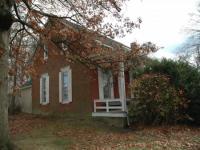
Menallen Preparative was set up as in 1748 by Sadsbury Monthly, having been an Indulged Meeting since 1733. In 1748, the meeting became part of Warrington Monthly Meeting, the registers of which show that the first marriage to be conducted at Menallen in 1751. Menallen's earliest meeting house was a log structure, which they tore down in 1838, and rebuilt on a new property in Flora Dale, about a mile south of Bendersville. About 1890, that structure was replaced by the red brick building currently in use.
Thursday, May 11, 2017
Very early settlement of New Jersey
My Moore group has been chatting about our Cureton ancestors. James and Rose Moore's son John married Jane Cureton. It is quite clear that Jane's family came over on the ship the Swan in 1685. They settled in the Welsh Tract almost immediately. However, we are not as certain how our Moore ancestors came to these shores. We find James and Rose Moore in what is now downtown Philly by 1684....just two years after Penn had the city laid out. Had they moved to these shores before and had been living elsewhere? Did they move just in time to buy land in the new Philadelphia? Our group is not sure. We also are not sure just where they were living before they climbed on board a boat that brought them to our shores.
Wednesday, March 15, 2017
Very early Hawkins families
Elaine and I were chatting this morning about some of the early Hawkins families. She mentioned all of the names that are found in the St. Paul's register that includes King George County and Stafford County, Virginia.
 I bought that book. I don't have time to look at it this morning. I would guess that it is Hawkins' that connect to Thomas of Old Rappahannock County....but don't know for sure. Here is the name of the book if I want to look at it on my computer at a later date. It should be on Google Play and is among the bookmarks on my computer. Oh, wow.....I need to spend some time on looking at my collection of books on Google Play....AMAZING!

The below map shows King George County and one can surmise where Stafford County is very easily. I won't add another map. Note that both are close to Fredericksburg which is at the falls of the Rappahannock River.

 I bought that book. I don't have time to look at it this morning. I would guess that it is Hawkins' that connect to Thomas of Old Rappahannock County....but don't know for sure. Here is the name of the book if I want to look at it on my computer at a later date. It should be on Google Play and is among the bookmarks on my computer. Oh, wow.....I need to spend some time on looking at my collection of books on Google Play....AMAZING!
The below map shows King George County and one can surmise where Stafford County is very easily. I won't add another map. Note that both are close to Fredericksburg which is at the falls of the Rappahannock River.

Friday, March 10, 2017
Jacob and Elizabeth Elliott in Pennsylvania
Ancestry just sent me a link to the copy of an original record that names the first four children of Jacob and Elizabeth Elliott and gives their dates of birth. The record is said to be from the Menallen Monthly Meeting in Adams Pennsylvania. I had not had this information before....well that may not be accurate. If I had this information before, it did not sink in. So this blog post is about where this Monthly Meeting was located and what it might tell me about proving parents for either Jacob or Elizabeth. [I saved this document to my Ancestry Tree]

Records of Menallen Monthly Meeting, 1733-1993. Includes men's and joint minutes 1780-1963, women's minutes 1780-1891, vital records 1733-1991, Ministers and Elders minutes 1884-1911, and miscellaneous 1851-1993. So it does not look as if there would be more information available during the time that Jacob and Elizabeth were in PA. By 1763 they had moved to North Carolina. Which brings me to the reason that I had assumed that they were from Warrington MM.

Menallen Monthly Meeting was founded in 1748 as a Preparative Meeting by the Religious Society of Friends (Quakers) and became a Monthly Meeting in 1780. It is an active spiritual community that supports its members and the surrounding community. In addition to weekly worship, we have a monthly spiritual study group and other activities including community outreach. Menallen Monthly Meeting (also known as Menallen Friends) follows the tradition of unprogrammed silent worship, and is a member of Warrington Quarter and Baltimore Yearly Meeting. So it seems that it is still an active meeting.
This is such a surprise to me as I had thought that the Elliott family had been located in the environs of Philly. Instead the map below shows the location of Menallen MM:

From the website: http://www.menallenfriends.org
In 1691, William Penn (a member of the Religious Society of Friends) founded a government and a society that welcomed all people and all religions. This tolerance attracted immigrants of varied religions and backgrounds, including many Quakers. By the 1730’s some of these families moved to York and Adams Counties in Pennsylvania. The percentage of Friends (Quakers)was significant. To support these new communities new Quaker Meetings were established, notably, Newberry (Redlands) Meeting in 1739, Warrington in 1745, Menallen Meeting in 1748 and Huntington Meeting in 1750.
At the time that Jacob and Elizabeth's children were born, Menallen was a preparatory meeting:
to hold regular meetings and for several years to come all members of Menallen Meeting were members of Sadsbury Monthly Meeting. However, upon establishment of Warrington Monthly Meeting in 1747, all Friends west of the Susquehanna River became members of the new Monthly Meeting. There is a description of where the original and also the newer meeting houses were built at this same site.
And from: http://thegenproject.com/quakers/meeting-info/baltimore-yearly/warrington-quarterly/menallen-monthly
Menallen Prep
Records of Menallen Monthly Meeting, 1733-1993. Includes men's and joint minutes 1780-1963, women's minutes 1780-1891, vital records 1733-1991, Ministers and Elders minutes 1884-1911, and miscellaneous 1851-1993. So it does not look as if there would be more information available during the time that Jacob and Elizabeth were in PA. By 1763 they had moved to North Carolina. Which brings me to the reason that I had assumed that they were from Warrington MM.
1763, 11, 26. Jacob (Ellott) & W& ch, Jacob, Elizabeth, Hannah, Israel & William rocf Warrington MM, Pa, dated 1763, 9, 20 (I have a copy of the original MM records for this) This is found in the records of New Garden MM in what is now Guilford County, NC. It would have been Rowan County in 1763
They would have taken a certificate from Warrington MM because at the time Menallen was not yet a MM. It was still just a preparative meeting.
Tuesday, February 7, 2017
County Donegal and the Morrison family
Donegal County in Northern Ireland and Morrison
I have been working a bit on the Morrison family lines that we find in Cabell and Wayne Counties in WV. I have recently found a participant to do DNA testing who is a part of these family lines. He has matched with the H2 Morrison family members that I have been chatting with for the past few years. When I got the news that he was an H2 match, you probably heard my WOO HOO from WV while you sat at your computer. I am very excited. My 4-gr-grandmother on Mom's side was Elizabeth Hensley. All of the old time researchers in our area assume that Elizabeth was a Morrison .....including Ruth Sammons Nassar. I have found very few wrong assumptions among Ruth's research writings. My gut feeling is that this is a correct assumption....but I just can't prove it. I will add my ideas on proving Elizabeth's connection as I have time. But today I want to jot down some ideas that I was thinking about while I drove to knitting today.
The first is that the folklore in the WV Morrison family group is that James and Rachel Morrison came from County Donegal in Northern Ireland. All of this statement is iffy. First, since I wrote this blog post back in Feb 2017, I have proved to my satisfaction that Rachel's husband was named William NOT James. My theory is that an early researcher called this man James and that the researchers who came after her/him continued the mistake. When Rachel's father died he left the land on which William Morrison now lives to the couple in his will
Second we now know that William Morrison who married Rachel Witcher was not the original immigrant. He is found in his father's home in Pittsylvania County in the tax list of 1773. I am quite certain that Patrick Morrison of Pittsylvania County is the father of William. It is not totally clear that Patrick did not come with parents or at least brothers.
And third the TN Morrison group who are DNA matches have folklore saying that four Morrison brothers arrived on these shores from Scotland not from Ireland. All of these groups of people are almost certainly from the same original immigrants!
But nonetheless, Here are my thoughts on Donegal. First of all. The original Morrisons of Scotland are said to have lived on the island that is marked below with the big red marker.
The first is that the folklore in the WV Morrison family group is that James and Rachel Morrison came from County Donegal in Northern Ireland. All of this statement is iffy. First, since I wrote this blog post back in Feb 2017, I have proved to my satisfaction that Rachel's husband was named William NOT James. My theory is that an early researcher called this man James and that the researchers who came after her/him continued the mistake. When Rachel's father died he left the land on which William Morrison now lives to the couple in his will
Second we now know that William Morrison who married Rachel Witcher was not the original immigrant. He is found in his father's home in Pittsylvania County in the tax list of 1773. I am quite certain that Patrick Morrison of Pittsylvania County is the father of William. It is not totally clear that Patrick did not come with parents or at least brothers.
And third the TN Morrison group who are DNA matches have folklore saying that four Morrison brothers arrived on these shores from Scotland not from Ireland. All of these groups of people are almost certainly from the same original immigrants!
But nonetheless, Here are my thoughts on Donegal. First of all. The original Morrisons of Scotland are said to have lived on the island that is marked below with the big red marker.
There is little in the way of historical information on the origins of Clan Morrison. It is generally accepted that the hereditary judges, or brieves, of the Isle of Lewis were chiefs of the clan until that office disappeared in the early 1600's. The seat of the brieves was at Habost in Ness, near the Butt of Lewis. One tradition is that this line of brieves were descended from a Morrison heiress of the original line and a Macdonald of Ardnamurchan who married her in the 1300's. The Morrisons of Harris claim to be of the original line.
The Isle of Lewis is marked with the big red marker below.
The Isle of Lewis is marked with the big red marker below.

Donegal is the pink area on the map of Ireland in the below map:

I think it is quite obvious how easy it might have been for some Morrisons to have moved from that far northern island to Donegal if they were fishermen or had access to boats.
I have to point out that while Donegal County is in the northern part of the Island of Ireland, it is NOT a part of Northern Ireland. Does that mean that it was not settled by the British during the period of the Scotch-Irish?
I asked on the Scotch-Irish list for input on understanding County Donegal in the context of the Scotch-Irish. John Polk was kind enough to send me the below with permission to add it to my post:
Donegal may not be part of what is now Northern Ireland but it is one of the nine counties of Ulster and was very much part of the Ulster Plantation beginning in 1609. I just checked the Donegal Hearth Rolls for 1665 and found 8 Morisons (sic) listed at that time.
Ulster Scots came to America and became what we call Scotch-Irish from Donegal just as from the other counties of Ulster. In fact the first recognizable Scotch-Irish community in America came mainly from the Area of Lifford in Donegal, following the lead of Rev. Francis Makemie (of Ramelton), to Somerset County Maryland in 1683. To see my article on this topic from The Journal of Scotch-Irish studies please go to http://www.mdgenweb.org/somerset/history/scotch-irish.htm
The main wave of Scotch-Irish to America began about 1715 and continued unabated up to the Revolutionary War, particularly into Pennsylvania and on down the Appalachians into Virginia and the Carolinas. If you want to see a list of names, the mother lode of Scotch-Irish settlers in Pennsylvania in the mid-18th century is here - http://www.phmc.state.pa.us/bah/dam/rg/di/r17-88WarrantRegisters/r17-88AllCountiesInterface.htm Just pick a county, particularly Chester, Lancaster, Cumberland, York, and start looking at the names on all the warrants that were issued at that time. I am sure you will find some Morrisons.
Ulster Scots came to America and became what we call Scotch-Irish from Donegal just as from the other counties of Ulster. In fact the first recognizable Scotch-Irish community in America came mainly from the Area of Lifford in Donegal, following the lead of Rev. Francis Makemie (of Ramelton), to Somerset County Maryland in 1683. To see my article on this topic from The Journal of Scotch-Irish studies please go to http://www.mdgenweb.org/somerset/history/scotch-irish.htm
The main wave of Scotch-Irish to America began about 1715 and continued unabated up to the Revolutionary War, particularly into Pennsylvania and on down the Appalachians into Virginia and the Carolinas. If you want to see a list of names, the mother lode of Scotch-Irish settlers in Pennsylvania in the mid-18th century is here - http://www.phmc.state.pa.us/bah/dam/rg/di/r17-88WarrantRegisters/r17-88AllCountiesInterface.htm Just pick a county, particularly Chester, Lancaster, Cumberland, York, and start looking at the names on all the warrants that were issued at that time. I am sure you will find some Morrisons.
The situation in Scotland in the 1700s was wholly different and more comfortable than it was in Ulster in both religious and economic terms. They had far less reason to emigrate although there were still many supporters of the Stewarts and Bonnie Prince Charlie who wanted to rebel against British rule. That met a sorry end at Culloden in 1746 after which a lot them were exiled to very parts of the empire. A large contingent of them settled in the coastal areas of North and South Carolina, but they had nothing to do with their Scotch-Irish cousins in the piedmont and Appalachian areas.
There is a really good book about them which I highly recommend as a general background - "The Scotch-Irish, A Social History" by James G. Leyburn. Perhaps you already have it.
The next crazy thoughts that I have are about my mother's Family Finder matches. I wrote a blog post several years ago about a man who contacted me about one of my mother's matches. This man asked me if we had McDonald connections. You can read it here:
It looks as if the Morrison Clan and the McDonald Clan shared home lands.
Wednesday, February 1, 2017
Family Group #1: Short Mountain, TN Hawkins group
I have become particularly interested in the subgroup in Family group #1 that I am calling the Short Mountain, Tn group. I find that almost every participant who is a part of this subgroup has some connection to Short Mountain or to Warren, DeKalb, or Cannon County, TN. I am going to add some information from some of these participants in this spot.
Nancy Pack had an ancestor with name Benjamin who has a connection:
I just sent an e-mail to Bret as I really believe we have a common ancestor in what would now be Warren Co. TN. ... His last known Hawkins ancestor Joseph lived and died in that area and my last known ancestor GGG Grandfather Benjamin Hawkins (maybe John Benjamin) died in Warren Co. TN (his will in my tree gallery) but was buried in Riceville, McMinn Co. TN. I think we may share either him or his father as a common ancestor. It would be so great if we could find that out!
and
Nancy Pack had an ancestor with name Benjamin who has a connection:
I just sent an e-mail to Bret as I really believe we have a common ancestor in what would now be Warren Co. TN. ... His last known Hawkins ancestor Joseph lived and died in that area and my last known ancestor GGG Grandfather Benjamin Hawkins (maybe John Benjamin) died in Warren Co. TN (his will in my tree gallery) but was buried in Riceville, McMinn Co. TN. I think we may share either him or his father as a common ancestor. It would be so great if we could find that out!
and
Nancy Pack’s line:
(Hawkins Group #1) (Dekalb County AL Hawkins—Steven Thomas Hawkins participant 59402)
Our earliest ancestor Benjamin Hawkins (1754-1827) was born in NC and died in McMinn County TN. We know from Benjamin's will that his wife was Mary and they had 10 children—Benjamin,Jr., James,Joseph, William, Nancy, Blanche, Polly, Sally, JOHN and Raleigh. In the Chancery Court Records of McMinn County TN there are disputes documented about the land Benjamin Hawkins had bequeathed to his wife Mary and their children. Depositions describe what happened to the children in the years after Benjamin's death. John Hawkins (our Great-great grandfather) and his brother Raleigh migrated to Dekalb County AL from the McMinn/White counties of TN about 1833.
By this time, John had married Elizabeth Cook and had six children. Six more children were born to them in Dekalb County AL---Benjamin,III, Alexander, Raleigh, Lucinda, John,II, Mahulda Jane, James, Preston, WILLIAM, Mary Ann, Jerusha, Blanchey. Raleigh (1800) also married Henrietta Beene and had several children in Dekalb County AL. Most of the descendants stayed in the area of Dekalb County AL and Dade County GA except for a few descendants who migrated to Arkansas and Texas. The first generation of John Hawkins and Elizabeth Cook are included on our Hawkins Family Tree on ancestry.com.
Our Great-grandfather WILLIAM C. Hawkins (1840-1872) married Mary Ann Beene (1845-1923) in Dekalb County AL in 1859 just before the Civil War. He was a union sympathizer but was conscripted into the service of the Confederacy in April 1862. He quickly deserted, hid out in the woods for 8 months--- then crossed federal lines and joined the First Tennessee & Alabama Vidette Calvary, Company C. He served as sergeant until honorable discharge in June of 1864. He was then employed by the United States to work on the military railroad until the end of the war. In 1872, he decided to join a wagon train going out west so he left Dekalb Co.AL with his wife and 3 children. (William Jacob, Nancy Elizabeth & JOHN PRESTON ) They did have Hawkins and Beene relatives in Arkansas so possibly that was their destination. Around Boles, Arkansas our Great-grandfather William C. Hawkins died and was buried in an unmarked grave. His wife Mary Ann had their fourth child (Amanda Jane) and promptly returned to Dekalb County AL with her four Hawkins children.
In 1874, Mary Ann finished filing a claim with the Southern Claims Commission that her deceased husband had started in 1871. (case no. 7538). In 1875 she took her mother, nephew and three neighbors to Cleveland, TN to give depositions proving that she and her husband had been loyal only to the union and had not aided the confedrate cause. She proved her case and received $366 for 280 bushels of corn, 100 bushels of potatoes, 7 sheep, six hogs and one good horse taken by the General McCook's army in September 1863.
Our grandfather JOHN HAWKINS (1869-1925) was quite industrious and adventurous. He left Dekalb County about 1900 and traveled south to Shelby County AL. He found work as a guard in the Longview Workcamp (1900 census) One evening, the warden Thomas J. Sanders took him home for dinner and he met the warden's daughter, IDA B. SANDERS. She was to be our grandmother. They moved a few miles away to an area of Bibb county called Six Mile and opened a general store---serving several mining towns that had cropped up as the iron ore was being mined out of the hills and dales of Shelby, Bibb and Jefferson counties. They also lived in part of the store which was situated at the fork of the Cahaba and Little Cahaba Rivers. (now part of a nature conservancy) About 1913, the store burned and they returned to Dekalb County and bought a farm in Lebanon, AL---the county seat at that time. The railroad was closeby and brought all the materials to build a house. They had six children—Horace, Mary B., John P., Chad, WILLIAM THOMAS & Warren G. Their mother Ida B. passed in 1923 and their JOHN P. HAWKINS in 1925 so the young children were reared by a half-uncle and neighbors. In 1923 their grandfather Papa Sanders and Ggrandmother Mary Ann also passed so they had lots of troubles but they all grew up to be hard working respectable people.
John Preston Hawkins (1869-1925)
& wife Ida B. Sanders (1879-1923)
Friday, January 27, 2017
Migration into Louisa County
A question came across the Louisa County mail list this morning about migration into Louisa County from Prince George County. I wanted to respond to this question because I also have an interest in just exactly where my ancestors were living before they moved to Louisa County. However, I haven't looked at the counties enough yet to know if they actually moved or if there were just boundary changes. Here is the question.
I found a possible ancestor, John Joyce, recorded in Louisa County in 1743,
but he disappears from the record afterward. Recently, I found a John Joyce
recorded in 1683 in a Prince George County Deed book. Have any of you
noticed a migration from Prince George to Louisa County, Virginia in your
research before?
OK....after doing the exercise below, I find that I have almost nothing of help to the man who asked the above question. Prince George County is way east of my families lands.....near Williamsburg. But the time spent below was helpful. I am inching my way towards knowing these early Louisa County ancestors.
In 1669 no one would have been living as far west as what is now Louisa. I find my Hawkins ancestors moving west from the Northern Neck into Orange and Culpeper around 1734. They moved up the Rappahannock River from Richmond County. And Germanna was settled in 1714 and 1717 on the Rappahannock River in what is now Culpeper County partly as a buffer between eastern settlements and the French and the Indians on the Frontier. But the counties that would have claimed this "frontier" land in 1669 would have been New Kent, Henrico, and Charles City as seen on the map below.

In 1691, King and Queen took a part of New Kent's territory:

In 1701 King William was formed from King and Queen:

And in 1702 Prince George from Charles City:

By 1720 families are beginning to settle farther west and Hanover and King George and Spotsylvania are formed in these western lands. Probably our ancestors who end up in Louisa are NOT in Brunswick.

And then in 1728, an important one for me ....Goochland is formed from the western part of Henrico.
I find that many of the early families that I look at have their beginnings (well....earliest I find them) in Goochland County.

Then the important date of 1742 when Louisa County is formed from the western part of Hanover County:

And another important for me event: Cumberland is formed from Goochland in 1749. Another of the counties that I look at a lot for my early ancestors.

My own Ancestors in Louisa:Her information
My Andersons and Carters found in Louisa County are said to have come from neighboring farms in Goochland County. My information comes from Pattie Cooke's book: Wartime Letters of Louisa County, Virginia: the Cooke Family Papers 1859-1866. : " “Jesse and Mary lived at one time in Caroline County, Va., but in 1843 they moved to Louisa County. They bought 385 acres from Elish Melton in the Northwest secion of Louisa.
Her information comes from a deed in a Goochland in 1843 in which Jesse Anderson and Mary his wife are said to have been "of Caroline County".
Oh, phooey....I wasn't expecting that....back to the maps. I was expecting Jesse and Mary to live in the same area as they had grown up before their move to Louisa. Here is Caroline County
 Mary's mother and father (surnames Scott and Carter) were married in Goochland County in 1802. But Mary's mother (Nancy Scott Carter) died in Cumberland County 1830.....whoops....whereever I received that information from is NOT right....Cumberland has not been created yet in 1830.
I found a possible ancestor, John Joyce, recorded in Louisa County in 1743,
but he disappears from the record afterward. Recently, I found a John Joyce
recorded in 1683 in a Prince George County Deed book. Have any of you
noticed a migration from Prince George to Louisa County, Virginia in your
research before?
OK....after doing the exercise below, I find that I have almost nothing of help to the man who asked the above question. Prince George County is way east of my families lands.....near Williamsburg. But the time spent below was helpful. I am inching my way towards knowing these early Louisa County ancestors.
In 1669 no one would have been living as far west as what is now Louisa. I find my Hawkins ancestors moving west from the Northern Neck into Orange and Culpeper around 1734. They moved up the Rappahannock River from Richmond County. And Germanna was settled in 1714 and 1717 on the Rappahannock River in what is now Culpeper County partly as a buffer between eastern settlements and the French and the Indians on the Frontier. But the counties that would have claimed this "frontier" land in 1669 would have been New Kent, Henrico, and Charles City as seen on the map below.

In 1691, King and Queen took a part of New Kent's territory:

In 1701 King William was formed from King and Queen:

And in 1702 Prince George from Charles City:

By 1720 families are beginning to settle farther west and Hanover and King George and Spotsylvania are formed in these western lands. Probably our ancestors who end up in Louisa are NOT in Brunswick.

And then in 1728, an important one for me ....Goochland is formed from the western part of Henrico.
I find that many of the early families that I look at have their beginnings (well....earliest I find them) in Goochland County.

Then the important date of 1742 when Louisa County is formed from the western part of Hanover County:

And another important for me event: Cumberland is formed from Goochland in 1749. Another of the counties that I look at a lot for my early ancestors.

My own Ancestors in Louisa:Her information
My Andersons and Carters found in Louisa County are said to have come from neighboring farms in Goochland County. My information comes from Pattie Cooke's book: Wartime Letters of Louisa County, Virginia: the Cooke Family Papers 1859-1866. : " “Jesse and Mary lived at one time in Caroline County, Va., but in 1843 they moved to Louisa County. They bought 385 acres from Elish Melton in the Northwest secion of Louisa.
Her information comes from a deed in a Goochland in 1843 in which Jesse Anderson and Mary his wife are said to have been "of Caroline County".
Oh, phooey....I wasn't expecting that....back to the maps. I was expecting Jesse and Mary to live in the same area as they had grown up before their move to Louisa. Here is Caroline County
 Mary's mother and father (surnames Scott and Carter) were married in Goochland County in 1802. But Mary's mother (Nancy Scott Carter) died in Cumberland County 1830.....whoops....whereever I received that information from is NOT right....Cumberland has not been created yet in 1830.
Saturday, October 22, 2016
Southside Virginia
I have spent the day today working on the organization of my many files and piles. It was a gorgeous day, but just a touch cold and the first day this fall (except for the one or two days of rain) that I have not been lured outside. One of the books that I found among my piles and files is Southside Virginia Families by John Bennett Boddie Vol I. I find that it is available to read on-line, so perhaps it is a bit of money that I didn't need to spend. But since it is in my hands, I thought I might take a look. First question is what is Southside Virginia? I turned to Wikipedia to answer that:
Traditionally, the term Southside refers to the portion of Virginia east of the Blue Ridge Mountains and south of the James River, the geographic feature from which the term derives its name.[1]

During the colonial era, Southside was considered the area where entrepreneurs settled, as opposed to some of the more established families in the Tidewater counties, although many early Southside settlers were younger sons of established Tidewater families.
Today, however, some people use a more limited definition of the region: those counties lying east of the Blue Ridge, west of the fall line, and south of the James River. That is to say, the southern end of Virginia's Piedmont region. While this definition describes an area long considered to be the heart of Southside, it also accounts for changes that have occurred in recent decades as the Richmond suburbs have eaten up large portions of Chesterfield and even Powhatan Counties.
While Southside has long been reputed for its isolated, rural, and culturally conservative character, in recent years the aforementioned counties have become increasingly linked to the Richmond metro area. Counties often considered part of this region include Patrick, Henry, Bedford, Pittsylvania, Halifax, Charlotte, Mecklenburg, Campbell, Lunenburg, Brunswick, Nottoway, Amelia, Prince Edward, Appomattox, Buckingham, Cumberland, Powhatan, Dinwiddie, and Greensville counties. The cities of Danville, Emporia, Lynchburg, and Martinsville, which under Virginia law are not located within any counties, are also considered to be in this region.
There was information about a Wooten family and also the Jordan family, but nothing that was helpful for my research. I will donate this book as it is available via the internet.
There was information about a Wooten family and also the Jordan family, but nothing that was helpful for my research. I will donate this book as it is available via the internet.
Subscribe to:
Posts (Atom)