Wednesday, August 21, 2013

Spotsylvania County, Virginia in early 1700's

It rained tonight.  So I am sitting at kitchen counter cleaning out my inbox.   I just deleted an e-mail from last February in which E.W. Wallace said:

"By the way, I discovered today that Ancestry.com has digitized at least one of the books of Spotsylvania early records compiled by William Armstrong Crozier. ...."

Ancestry.com. Spotsylvania, Virginia County Records, 1721-1800 [database on-line]. Provo, UT, USA: Ancestry.com Operations Inc, 1997.
Original data: Crozier, William Armstrong, ed.. Virginia County Records: Spotsylvania County 1721-1800. New York, NY, USA: Fox, Duffield, and Co., 1905.

and

When Spotsylvania County, Virginia was formed in 1721, it covered an area which now includes Orange, Madison, Culpeper, and Rappahannock counties. This collection of records contains information on wills, deeds, administrators' and guardians' bonds, marriage licenses, and lists of revolutionary war pensioners. Each entry reveals valuable information on persons, dates of vital events, places of occurrence, and relationships, all extracted from the original courthouse records.

Of course, the first thing that I do is go to:  http://homepages.rootsweb.ancestry.com/~george/countyformations/virginiaformationmaps.html

to see what Spotsylvania County looked like in 1721 and what the areas were before that date.

So you can see in the 1721 map that Sp is the abbreviation for Spotsylvania County.  It is certainly pretty much on the frontier of that time period and it has taken the place of western Essex County (ES), and western King and Queen County (KQ).  In the same time period Hannover County was taken from the Western part of New Kent.  So it seems that these areas were being settled in this time period.  My gut feeling is that these families had lived in the Northern Neck and sons who did not inherit or families that had reason to move had moved west.  Certainly it is also possible that these people had lived here as we find that Thomas Hawkins of Old Rappahanock County had owned land at what is now Fredericksburg as shown in the map below:


So the family that seems to have wills in this county in this era is Nicholas Hawkins who was married to Elizabeth Long.  Here are some of the wills that are in Crozier and available on Ancestry:

Virginia County Records SPOTSYLVANIA COUNTY 1721-1800
WILLS
WILL BOOK A 1722-1749
page 5
ALLEN, THOMAS, St. George's Parish, d. Nov. 10, 1743, p. Feb. 7, 1743. Wit. JohnHawkins, James Jones, Nick Jones. Ex. wife Elizabeth and son Nathaniel. Leg. son Thomas; son Nathaniel; daughter Elizabeth; grandson Robert Hall; wife Elizabeth; son John. (Page —)
View Full Context

It is possible that this John could have been the John married to Mary who had the daughter Mary who married Tolliver Craig.  He is said to have died in Spotsylvania County c. 1740.

Virginia County Records SPOTSYLVANIA COUNTY 1721-1800
WILLS
WILL BOOK A 1722-1749
page 8
[p.8]BYRNE, EDMUND, Spotsylvania Co., d. Aug. 17, 1744, p. Sept. 4, 1744. Wit. James Mills, JosephHawkins, Edward Wars. Admr. JosephHawkins. Leg. my brother (page torn) and Thomas Byrne of the Co. of Kil-kenney, in the Kingdom of Ireland, whom I do appoint and constitute my joint heirs. (Page 397)
View Full Context

There is a Joseph Hawkins married to Jane Nicholas who lived in Spotsylvania County from about 1706 to mid 1700's.  It is possible that this Joseph Hawkins was a son of the John and Mary Hawkins that I name above

The next wills belong in the family group that is connected to Nicholas Hawkins who married Elizabeth Long.  It is possible that he could have been a brother to John Hawkins who was married to Mary.  They are born in the same time period.  The first will is that of Elizabeth Long Hawkins' father:
Virginia County Records SPOTSYLVANIA COUNTY 1721-1800
WILLS
WILL BOOK B 1749-1759
page 10
LONG, JOHN, St. George's Parish, d. Jan. 31, 1750, p. July 7, 1752. Wit. Philip Vincent Vass, Thomas Merry. Ex. wife, Elizabeth Long. Leg. wife, Elizabeth; grandson JohnHawkins; daughter, ElizabethHawkins; granddaughter, ElizabethHawkins. (Page 116)
View Full Context

The next belongs to Nicholas Hawkins:
Virginia County Records SPOTSYLVANIA COUNTY 1721-1800
WILLS
WILL BOOK B 1749-1759
page 10
HAWKINS, NICHOLAS, Spotsylvania Co., d. Feb. 15, 1754, p. May 7, 1754. Wit. Owen Thomas, Benjamin Martin, John Button. Ex. wife, Elizabeth and son, JohnHawkins. Leg. son, John; daughter, Cate Mac-donel; son, ThomasHawkins; son, NicholasHawkins; son, AlexanderHawkins; daughter, Ann Pritchett; grandson,HawkinsCasel. (Page 198)
View Full Context

Virginia County Records SPOTSYLVANIA COUNTY 1721-1800
WILLS
WILL BOOK D 1761-1772
page 21
LONG, ELIZABETH, St. George's Parish, d. Mar. —, 1760, p. Dec. 4, 1764. Wit. William Poultney, John Gordon. Ex. Nicholas.Hawkins, Senr. Leg. grandson, JohnHawkins; granddaughter, Elizabeth; grandson, NicholasHawkins, Junr; granddaughters, Mary, Nanny and Sarah; NicholasHawkins, Senr., father of the above named children. (Page 166)
View Full Context


The next Will is that of William Ellis who was the father of Elizabeth Ellis who first married John Hawkins who was the son of Nicholas and Elizabeth Long Hawkins.  This John Hawkins died relatively young leaving orphans: Catherine, Elizabeth, Ann, Agnes/Agatha, 
Virginia County Records SPOTSYLVANIA COUNTY 1721-1800
WILLS
WILL BOOK D 1761-1772
page 23
ELLIS, WILLIAM, Spotsylvania Co., d. May 19, 1766, p. Aug. 4, 1766. Wit. W. Wood, John Gordon, Isaac Wilson, James Dudley. Ex. wife, Elizabeth; sons Hezekiah and William Ellis, Col. Joseph Brock. Leg. daughter Mary Proctor; son Hezekiah Ellis; daughter ElizabethHawkins; daughter Ann O'Neal; son William Ellis; son John Ellis; daughter Agnes Ellis. If my wife should die before my son arrives at the age of twenty years, I desire that Robert O'Neal take his estate into his possession. (Page 241)
View Full Context

Elizabeth Ellis Hawkins married Robert Collins before 1772.
Virginia County Records SPOTSYLVANIA COUNTY 1721-1800
WILLS
WILL BOOK D 1761-1772
page 27
HAWKINS, JOSEPH, Spotsylvania Co., d. Mar. 30, 1769. Wit. Philm.Hawkins; Charles Cosby; W. Robinson. Ex. wife Jane and sons John and JosephHawkins. Leg. wife Jane, the tract of land left me by my father with that part of the back land that I purchased from Bernard Moore, Gentl; son Joseph land adjoining James Jones, Edward Coleman and others; my two daughters Lucy and SarahHawkins. (Page 525)
View Full Context

There are 140 or more entries.  It is very interesting to read who is living in Spotsylvania County in this time period.  However, that is all the time I have tonight to spend on this.  I just did not want to loose the thought when I deleted the e-mail.

Monday, August 12, 2013

McKinsey in Virginia

Harriet, Bruce and I have chatted about the possibility that George McKinsey who is 5-gr-grandfather to both Bruce and me may have had roots in Northern Virginia.  I have made reference to this fact in the a post that I began and did not finish:

http://www.marshamoses.blogspot.com/2013/07/timeline-for-george-mckinsey-and-family.html

Every time I begin to think about the McKinsey name in Northern Virginia, I find that I have forgotten more than I know.  So this post is miscellaneous McKinsey information from that area in the right time period

In Wilmer Kerns' book:  Frederick County, Virginia: Settlement and Some First Families of Back Creek Valley 1730-1830 I find the following on page 16:

"Two pages from a Frederick County Parish record show signatures of parishioners who participated in the communion (Eucharist) during 1761-1763.  The register was found in an original book among miscellaneous Frederick County records in the Virginia State Library, Archives Division.  At the top of the register is this statement:  "I declare that I do believe there is not any transubstatiation in the Sacrament of the Lord's Supper, and in the Elements of Bread and Wine, at or after the Consecration thereof by any Person Whatsoever."  This was one way of saying that the communion table was for Protestants only.

Some person who signed the parish register were:  Nicholas M_____(German), John Hite, Jacob Morgan, Thomas Caton, Mandley, James Craik, James Ireson, John Neaville, John McKensie, John Cristopher (Heintz?), James Keith, Thomas Speake, Lewis Moore, Cornelius Vansdell, Peter Hog (on June 1, 1762), Joselph Longacre (a German Signature), Joseph Glass, John Lindsey, Thomas Bryan Martin, John Sheen, Richard Paris (Pearis), John Watson, John Taylor, Edward Robinson, David Shepherd, Jeremiah Odell, John Shealy (his X mark---the only person who could not sign), Charles Smith, Gabriel Jones, Thomas Rutherford, Thomas Whitson, William Overall, Thomas Wadlington, Archibald Wager, Hunprhey Wells, Issac Russell, Thomas Lowe, John Kennedy, Joseph A____not legible, Elijah Isaacs (?), John Linsey, Daniel Bush, John Edwards, Edward Rogers, Jr, Morgan Morgan, Walter Moffett, John Waton (German), Van Swearington, John Wager, Wastley Whit, John Dark, Alex Lemen, John Jenkins, Martin _____ (German), Richard Jackman, Adam Stephen, Burr Harrison, Angus McDonald, Thomas Helm, and Henry Netherton.  With several exceptions, this list represents persons in the power structure of Frederick County in 1761-1763.  I

On page 11 Wilmer says that during the late 1740's there was a major migration of settlers from this area to the Carolinas due to disappointments over land policies of Lord Fairfax.  It has been told that some settlers paid twice for their lands.

I will add more as I have time.

Monday, July 29, 2013

Timeline for George McKinsey and family

This timeline will include a George and Margaret McKinney who lived in Old Frederick County who may or may not have been MY George McKinsey's parents.  I have not yet done that research for myself.  However, I am including them as there are lots of reasons to believe that they may have indeed been the George McKinney who bought the land in SC that I find MY George living on when he was raising his children in Newberry County, SC in the late 1700's and early 1800's.

1771  More information about the below and a map that was sent to me by Bruce Locken can be found on my blog post:

http://marshamoses.blogspot.com/2012/07/mckinney-and-geertsema-map.html


At the WV archives I looked at a book with title of  Frederick County Deeds 1771-1775 abstracted and compiled by Amelia C. Gilreath.  Here is the abstraction found for George McKinney on page 17 of this book:

Bk 15, P 92-6 Aug 1771
    [Lease]  Between George McKenny of the County of Frederick [to] Thomas Campbell of the said county.....consideration of five shillings.....Tract of Land of Musty Handley....Containing one hundred and ninety four Acres Granted to said George McKenny by Deed from the Hand and Seal of the Right Honorable Thomas Lord Fairfax the 18th Oct 1756....Yielding and Paying rent of one pepper corn on Lady day next.....
Wit: Jacob Sowers, Jun                     George (O) McKennie  
      Thos. Wood
Recorded:  7 Aug 1771

Bk. 15, p. 93--7 Aug 1771
    [Release] Between George McKennie and Margaret his wife of County of Frederick [to] Thomas Campbell of the said county .....consideration of one hundred and thirty pounds....194 acres (same as above)....
Wit: same as above              George (O) McKennie 

1773 

Newberry SC Deed Book D2, pp. 5-11:  Lease and release.  8 Jan 1773, Thomas Shaw and wife Sarah of Craven County, SC, to George McKinny of same, for £250 SC money, 150 acres in Craven County adj. William Hilburn, Nelson Dunkin, part of tract granted to said Thomas Shaw 10 Sept 1765, 100 acres of which is laid off to said Nelson Dunkin.  Thomas Shaw (Seal), Sarah Shaw (Seal), Wit: Wm Mills (M), Wm. Hilbirn, Richard Holeman.  Proved in Ninety Six District by the oath of William Hilburn 28 Aug 1773 before Michael Dickert, J.P.  Recorded 16 June 1797.

Newberry SC Deed Book D2, pp. 12-17: Lease and release.  21 & 22 Jan 1779, William Hilburn and wife Jane of Ninety Six District, farmer, to George McKinney of same, for £200 SC money, 100 acres on waters of Bush River adj. Mathias Elmore, Thomas Shaw, granted 3 Sept 1774 to said William Hilburn.  William Hilburn (mark) (Seal), Jane Hilburn (mark) (Seal), Wit: William Hilburn, John Ellemon, Abner Ellemon.  Proved in Newberry County by the statement of John Elleman 30 May 1797 before Fred Nance, J.P.  Recorded 16 June 1797.

1781  Oldest child known by Ruby Mundell Wallace in her book about George and Sarah's descendants is born:  David, born 25 March 1781.  If this is this couple's firstborn, they are likely to have married in 1780 or before.  

1840  George McKinsey died 11 June 1840 in Waynesville, Ohio

Friday, July 26, 2013

Loyalists in the Bush River area of South Carolina during the Revolution

A lady by the name of Ruby Mundell Barry wrote a book that I read via fiche in my local LDS FHL many years ago.   Ruby Barry did an amazing job of naming the descendents of my 5-gr-grandfather, George McKinsey.  George moved his family from Bush River area in Newberry SC to Warren County, Ohio in the first decade of the 1800s with the mass exodus of the Quaker families out of the south and into the non-slave states of Ohio and Indiana.

Ruby explained that the family lore said that George had served in the Revolution but that she had never been able to find service records nor pension records nor anything at all that supported that family lore.  I made my own searches and had no more luck than Ruby.  Harriet Imrey and I were chatting one night via internet when she found for me the fact that the reason that I had never found anything was that George had been a loyalist!  I was expecting George to have been a patriot.  I had even hoped to find George having served with the Swamp Fox.  What a revelation it was to me to find him on the Loyalist side!  It has opened up my research in many ways!

George was not in the Quaker records of the Bush River area, but he interacted with the Quaker families and lived close to Bush River MM.  His wife was of a Quaker family and I suspect that George's ancestors may have been Quaker ....perhaps in the area around Hopewell MM in the early 1700's.  My gut feeling is that George, like many of the Quaker families, hoped to sit the Revolution out.  The Quakers did not believe in fighting.  But even more than that they felt their first allegiance to God and did not have a strong allegiance to any sort of government agency.


By July 4, 1776 the Patriots had gained control of virtually all territory in the 13 colonies, expelling all
royal officials.  However,  Ms. Clark explains in the beginning of her book, Loyalists in the Southern Campaign, Vol I,  that after Charleston fell to the British in May 12, 1780 it was necessary for the British to re-establish the Loyal Militia.  Sir Henry Clinton established guidelines that called for young men to serve six out of every twelve months.  Thus if one was living in South Carolina in the timeframe that George McKinsey served in the SC militia which was Dec 1780, you were called up by the British who were then in control.  If one did not have strong loyalties one way or the other, it would only makes sense that you would obey the law of the land.  And indeed that is just what George McKinsey did.  He showed up for militia duty from the 14th of June until the 13th of December in 1780.

The map below shows the Dutch Fork which is the area that is is between the Saluda and the Broad River where they fork together, forming the Congaree River.  George McKinsey lived in this area just south of the town of Newberry.


I find him on the pay abstract for Colonel Daniel Clary's Regiment, Dutch Fork Militia, Ninety Six Brigade for soldiers who came to Orangeburgh, SC, with Lieut Colonel John H. Cruger, for 183 days pay from 14 June-13 Dec 1780.  There is quite a long list of men on this list.  Some of the names that I recognize are:  Daniel Regan, John Pearson, John Elmore, William Wyatt, Samuel Dunken, George McKinney, William Elmore.  The Duncan family were next door neighbors to George and his family.

George is found again the next year in the same time frame (14 June- 13 Dec 1781) on Daniel Clary's Regiment, Dutch Fork Militia, Ninety Six Brigade for 183 days pay.  The other men that I recognize during this service are:  John Elmore and Samuel Duncan.

It is quite likely that George McKinsey was present for the battle of Musgrove's Mill:


Musgrove’s Mill Aug 18 or 19th 1780

Edward McCrady notes in his History of South Carolina in the Revolution, 1775-1780, that the camp at Musgrove’s Mill prior to August 19, 1780 was commanded by Major Fraser, and that it also included Captain Abraham DePeyster of the King’s American Regiment, the North Carolina Loyalist David Fanning, and Colonel Daniel Clary’s militia. Clary’s regiment had been ordered to be formed to support Major Patrick Ferguson according to Lambert’s South Carolina Loyalists on page 105.   The park ranger indicated that the men were camped at Musgrove’s Mill with the goal of meeting Ferguson at Kings Mountain. 

It is not absolutely clear that Col Clary’s regiment had reached Musgrove’s Mill by the 18th.  Col Cruger informs Lord Cornwallis that he has ordered Clary to support Ferguson in a letter dated Aug 4th.  It would have taken Col Clary a few days to get his regiment assembled and they they would have had to move out and move to the site.  

However, the patriot detachment was informed by a local when they had moved within a mile of the incampment that the camp had been reinforced the previous evening and that there were now in camp a number closer to 500
It has been noted that most of the wounded and prisoners mentioned were Provincials, so the militia may not have been involved as heavily as the regulars. 

and from Harriet Imrey an explanation of what George McKinsey was doing during his service in 1781:


The Dutch Fork Regiment was not involved in the defense of Fort Ninety-Six.  By Jun 1781, that was the last remaining British outpost in the backcountry.  Gen. Greene and his Continentals had besieged it, but had to retreat when Lord Rawdon brought his newly-arrived Irish regiment up from Charlestown to relieve the fort on 21 Jun 1781.  Rawdon had already decided to abandon the outpost, but his couriers carrying that instruction to Col. Cruger kept getting killed en route.  A major consequence of the retreat was that local Ninety-Six Loyalist forces (and their families) would have no protection from reprisals by the Whig neighbors.  They were all offered refuge within Charlestown, the only small area with enough Loyalist and/or British forces to shelter a large group.  Around 800 militiamen of Ninety-Six District, with families and all moveable possessions, chose evacuation.  They had to make the long march down to Charlestown via Orangeburgh Road, a process that took most of July and involved civilian casualties from illness and exhaustion.  The local militias, including the Dutch Fork Regiment, were mustered to guard the retreat.  That's what George McKinsey was doing in Orangeburgh when Col. Cruger submitted a request for his back pay for the previous year.


I have some information that Harriet Imrey sent me that is helpful that I am not posting today.  I also have a note:

There is an excellent explanation of the Revolution in the Dutch Fork in the years that George was paid for militia duty.  Pp 42-53 in book: The History of Newberry County South Carolina Volume One 1749-1860 by Thomas H. Pope.


I want to read some of the articles at:

http://www.sciway.net/hist/periods/revolwar.html
and
http://musgrovemillmilitia.blogspot.com

Monday, July 22, 2013

Moore Family and relationship to Merion MM in Pennsylvania

Merion Meeting House


A discussion came up on the Quaker mail list today that mentioned Merion MM.  I knew that it was familiar to me, but had to do a bit of hunting to remind myself of which of my ancestors was connected to this area and in what time frame.  I have a slideshow that is named Pennsylvania Monthly Meetings in which I had made notes about my Moore family and their connection to Merion MM.  For more information about this Moore family use the search box in the top left hand corner with subject Moore.


Much of my information on my Moore family comes from Joseph Moore whose work was published in the Georgia Genealogical Society Vol 44, Number 1, Spring 2008.  Mr. Moore in turn has given credit for some of his information to Marjory Dickey Parsons  (1916-2007) who was the author of Lines and Lifestyles: Dickey, Moore, Parsons, and Some Related Families (Balimore: Gateway Press, 1988).


I have not done this research for myself.  However, Mr. Moore says that John and Jane Cureton Moore had children who are documented in the Register of the Radnor Meeting among whom is Richard Moore, Sr (1697-c.1784) who is the patriarch of the Moore family in Georgia.  It is this Richard Moore who is my 8-gr-grandfather.  My own research does indeed connect me with documentation to Richard Moore's son, Mordecai Moore who was living in Wrightsboro, Ga during the Revolutionary War.

Mr. Moore explains that John and Jane Cureton Moore were living in Merion Township by 1702.  This would have been Philadelphia County (now lower Merion in Montgomery County). John Moore and members of his family are buried in the cemetery at Historic Merion Meeting House in the area long known as the Philadelphia Main Line.  In 1702, John Moore acquired a farm on Cobbs Creek and Indian Creeks in Blockley Township, Philadelphia County, where Cobbs Creek is now located.  This property remained in the Moore family well into the 19th C and included water-powered mills on Indian Creek.


It is very clear just where John and Jane were living from info above on this map below.  It would be just where 69th St Terminal is on map below.  Township Line Road is the same as Rt 1 and City Ave on preceeding map, so Merion MM would be North west of the Moore farm
March 2014, Rick Duran sent me the AMAZING information that he found on-line that shows exactly where the Moore family lived!  I was off by a very small amount above.  The homestead was actually across Cobbs Creek from the Terminal on above map ....My best interpretation is that it is now a golf course through which the area of the original farmstead is where Landsdale Ave and Cardington Road now go through Cobbs Creek Park.   Rick gave me the co-ordinates marked by the yellow push pin below which I interpret to be the spot on Cobbs Creek that marks the corner of the Moore homestead with the corner of the Edward Williams Homestead.


 To see the Blockley Township Landoners in October 1777 prepared by J.M. Duffin go to:

http://www.archives.upenn.edu/histy/features/wphila/maps/atlas1777blockley_duffin.pdf

The land owned by James and Abel is found on plate 10.  This makes excellent sense because my data base says that John and Jane Cureton Moore's oldest son, James:

The paternal 100 acres homestead plantation on Mill Creek was conveyed to James Moore by Deed of 19th of 8th month (Oct.) 1721.  http://wc.rootsweb.ancestry.com/cgi-bin/igm.cgi?op=GET&db=jcfinley&id=I98564

This James Moore did indeed have a son named Abel who almost certainly was named after his mother's father, Abel Thomas.  


Rick sent another URL for a map that is found in the American Memory Collection at the Library of Congress site.  The Moore homestead is shown on this map on Cobs Creek.   The map is

A plan of the city and environs of Philadelphia. Engraved and published by Matthew Albert Lotter


The map below shows where Merion Meeting house is in relationship to Philadelphia today.  Merion Meeting House is located in within the pink area marked with A.  


Here is one more map that shows were Cobbs Creek is in relationship to Merion Meeting House. The marker with the A does not show the exact location of the meeting house itself.  The meeting house is in the V formed by the intersection of Montgomery Ave and Meetinghouse Lane.   Look straight down from Merion to find Cobbs Creek on the map.


In an e-mail on the Quaker mail list on this date, Tom Hill said:

Merion MM records are at Swarthmore's Friends Historical Library
(FHL) and on LDS microfilm.
https://www.quakermeetings.com/Plone/search_display?MeetingName=Merion 

Elizabeth Hanesbury on the Old Chester County mail list reminded me that the list of those buried in the Merion Meeting House Cemetery is on line.  One can find it in the archives of the Old Chester County Mail list.  In looking for the link for that I found the following link:

http://www.lowermerionhistory.org/burial/merion/

Sandra Ferguson sent information to the Pennsylvania Old Chester County mail list about Lower Merion Township.  I had to look to see if this was the area of interest to me:

  • Lower Merion: Ardmore, Bala, Bala-Cynwyd, Belmont Hills, Bryn Mawr, County Line Sta, Gladwyne, Haverford, Merion Station, Narberth, Penn Wynne, Rosemont, Roseglen, West Manayunk, Wynnewood
Absolutely!  So here is the URL for this site:

Wednesday, May 8, 2013

Hare/O'Hare in Armagh Ireland

My Grandmother Hawkins was 4th generation Californian when she married my grandfather Hawkins and moved to West Virginia.  Her name before she married was Mary Ann McGregor.  And her family folklore was as romantic as her name.


Her parents were James McGregor and Helen McKinsey.  Today's blog post is about her McGregor side of her family.  James McGregor was the son of Robert McGregor and Mary Ann Hare.  It is not actually the McGregor side that I am talking about, but instead it is her mother's family:  Hare.
I found Mary Ann Hare's maiden name spelled differently in various documents in California.  I decided on this spelling of her name because the website Irish Times shows 42 Hares in Armagh County and NO Hair families.  It also says that there were no O'Hair households in Griffith's Valuation.  There were 120 O'Hares in Armagh in mid 1800s.  Down had 312.  So almost for sure Mary Ann was either Hare or O'Hare.

On the death certificate for Mary Ann Hare's son, James McGregor, the maiden name of his mother is typed in as Mary Ann Hare with birthplace of Ireland.  The information is given by his sister, Anna A. McGregor who is as likely to have known her mother's maiden name as anyone.

I have recently heard from another researcher in Ireland who sent me the following:

Hi, I'm looking for a William Hare/O'Hare born in the Parish of Ballymore, location Aghantaraghan, circa 1792 and died circa 1852 in the Kilkeel workhouse in County Down. Most people know him as William Hare but there is a strong chance he was born as William O'Hare, in 1830 there was a Michael Hare and a Owen O'Hare in the Parish of Ballymore, location Aghantaraghan.. Any suggestions?

My gut feeling is that this man and I are cousins!  I don't know how many generations we will have to go back, but I have a strong suspicion that Mary Ann Hare was from County Armagh.  I have no proof at this time....just a gut feeling.

I began by checking to make sure that the place that the researcher had sent me was indeed in Armagh. And the answer was YEP:

from:  http://www.igp-web.com/armagh/townlands/Aghantaraghan.htm


From the index of deaths 1853-1950 on microfiche that I ordered from the LDS Fiche #1819684 (Deaths K-Z Butte county Ca.  1853-1950) that I looked at at the LDS Library, Mary Ann's place of birth was listed as Moughen, Ireland.   Her son said in a letter to his daughter's future father-in-law that Mary Ann had been born in Northern Ireland.  Several years ago before a planned trip to Ireland, I chatted with researchers on the internet and did some research on my own to see if I could figure out the most likely places that Mary Ann might have been born.

There does not seem to be any place in Ireland spelled just exactly like Moughen.  A lady named Patricia sugessted that she had checked a Townland book and she thought it might be 

Townland:  Moghan
Parish:         Donaghmore
Barony:       Dungannon
Tyrone:       Tyrone

I also considered the county of Monaghan which is not in Northern Ireland but certainly is in the north of Ireland.  

However, the place that seemed to jump out at me as most likely is one that I found in the book Genealogical Atlas of Ireland by Gartner, Harland and Smith.  There is an index in the back of the book and the only spelling that is close to that given in Mary Ann's obituary is Moughan.  It is found on the Armagh map just south of Markethill.  It is located in Lower Fews Barony but VERY close to Lower Orior Barony.  


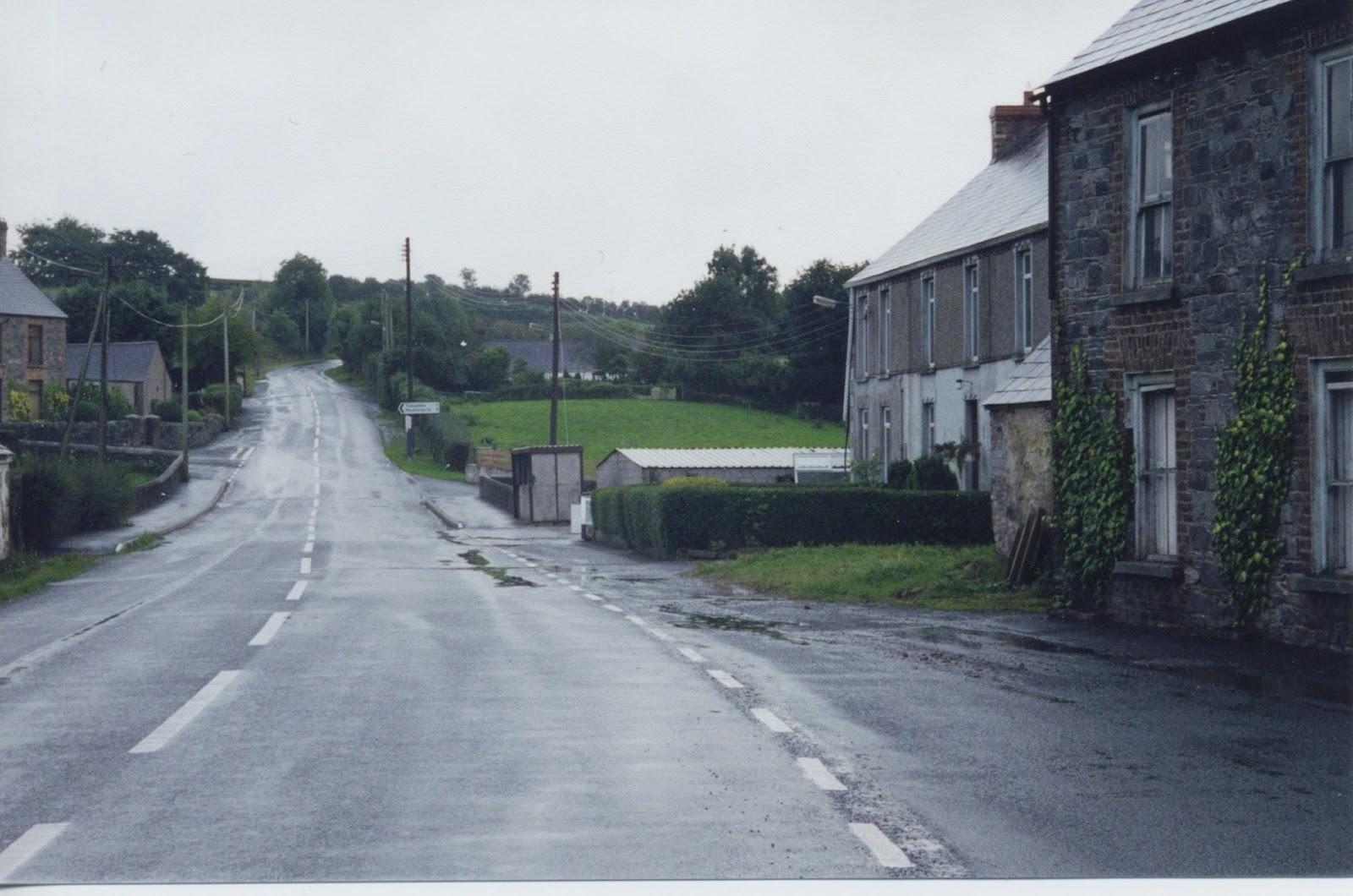
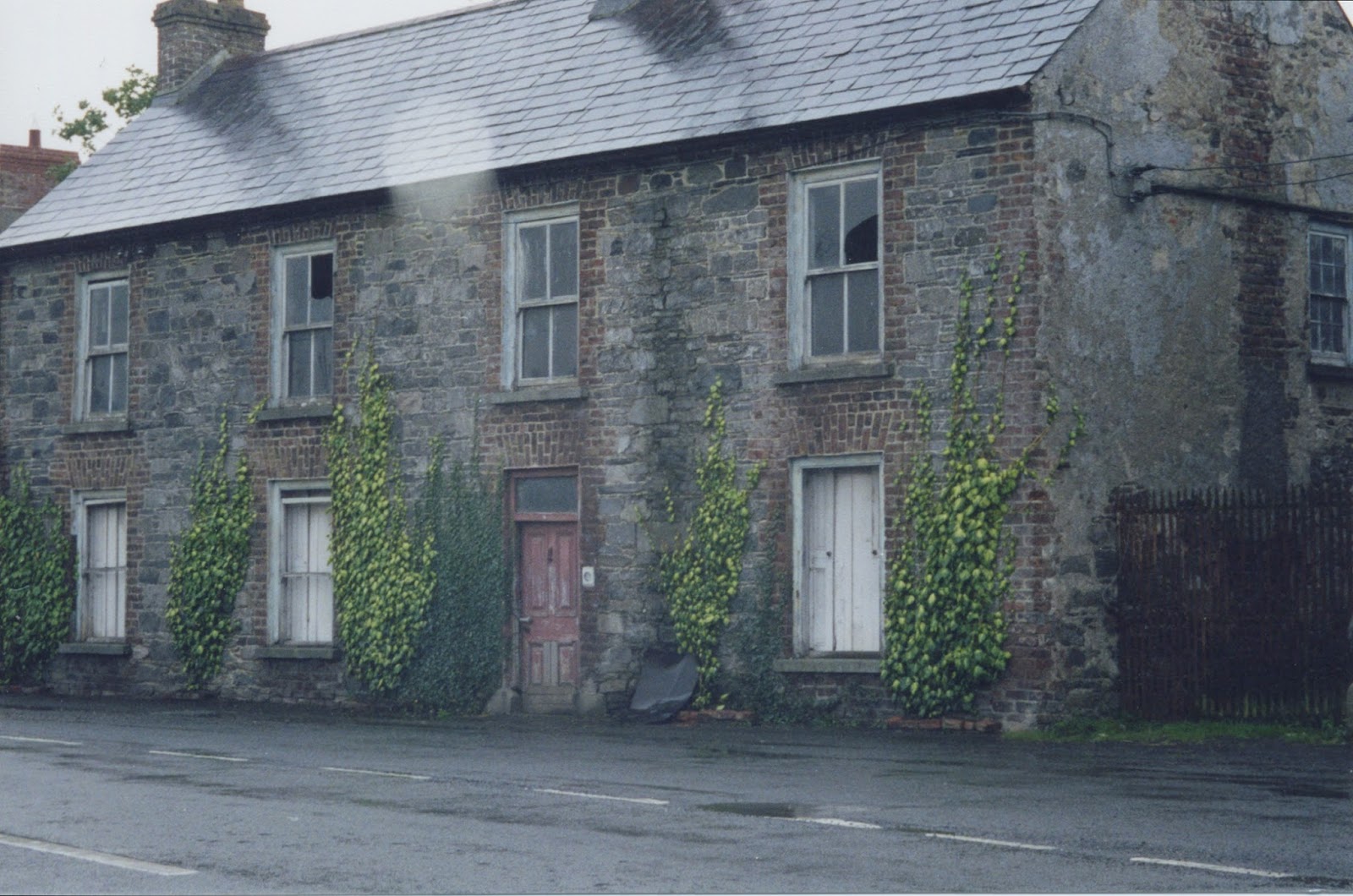
I visited the site that is marked on the above maps as Moughan in September 1999 and the sign post on the road says Mowhan.  In 1999 it was just a wide place in the road with some empty buildings and the sign post.  I will add photos from this trip.


As additional support to that being a probable place for Mary Ann's birth is a map that I found on-line showing areas where surnames are found in Ireland:


Ian Maxwell in his book:  Researching Armagh Ancestors Says on page 7: "The distribution of names in County Armagh illustrates the limited success of the plantation in the region.  The most popular surnames are almost equally divided between Irish and settler surnames.  Murphy, the most common surname throughout Ireland, is also the most popular found in County Armagh.  This is followed by Hughes, Wilson and Campbell, representing settler families, then by the Irish name of O'Hare, and Smith, the commonest name in England and Wales.  ....."

There is an excellent description of Armagh County in the late 1700's and early 1800's in the introduction of Maxwell's book.  There is also an excellent overview of the famine and fevers.  Mr. Maxwell says: "...in July and August 1846 blight struck again the impact was devastating throughout the county.   I think that not only was this disaster the impetus to push my Mary Ann to emigrate, but also likely to have been the cause for my potential cousin's William Hare to have moved to the work house in County Down.  Mr. Maxwell says that during the late 1840s and in the years immediately after the Great Famine some families were evicted from their smallholdings by landlords in need of rents which could not be paid or anxious to consolidate the farms on their estates."  He also comments that the devastation was even more severe in Armagh because it happened in a period of time that was suffering from a slump in the linen and cotton trade. 

I want to put the names that Robert and Mary Ann named their children as they are likely to have named them after parents or siblings.  Robert was the oldest and born c 1854.  George and William were sons for which I have no birth dates.  There were three daughters Katie, Emma and Annie for which I also do not have birth dates.   James A. McGregor is the son from whom I descend and I suspect that he was the youngest child born in 1869.

While Sarah was attending Boston University, she did a semester abroad in Dublin.  We decided to take all of the kids to Ireland to visit.  We visited both the north and the western part of the Island and, of course, spent time in Dublin as well.  On our way home from Northern Ireland we drove through Mowhan and I took photos of the area as I suspected that Mary Ann Hare might have been from the area.  Here are the photos that I took at that time:


When I have time, I will go through the notes that I made from the class "Paddy on the Internet".  I would like to pursue the clues that a brother got the family land....which would mean that there should be a Hare male living on land after 1850 who would be a relative.  I would also like to look at Griffith's Valuation.  I need to think through if there are more ideas of things that I could look at in NY and CA that would give me clues for Irish roots for Mary Ann.  I would also like to see if there is a picture of Mary Ann among Granny Mary's "things".  It would be good to add the photos of the cemetery and of Cherokee into another blog entry to tie in here.  

In 2022, I am adding some information that was given to me during a  "work at your own pace" class about Scotch-Irish Research.  It is perhaps something to look at as well:

On my next trip to PRONI (in 2023) I would research the Estate records for the Gosford Estate near Markethill. Archibald Acheson, Earl of Gosford was a Scottish Servitor from around Edinburgh who received estate lands near Markethill, County Armagh around 1620 as part of the Plantation scheme. There are over 40,000 pages of Gosford Estate records at PRONI. Where does one start? The Gosford Estate records are not well described in the PRONI catalog.

Summer 2013 I received an e-mail from Jill in Australia asking me if I had more information.  (I have filed Jill's e-mail in folder labelled Hare)


Saw your posting on internet and wondered if you have anymore info on the Hair / Hare family that you’d be able to assist me with.

I’m tracing the family of John Hare / Hair  & Eliza Riddle, particularly their daughter Charlotte Hair who married Joseph Gibson.


John Hare & Eliza Riddle married (according to the info below) 28 Jan 1857
 Kildarton, Arm, Ireland, John”s Father was David Hare. The info on their son
John Thomas /Hare states he was born 1 April 1867 Market Hill, Armagh, Ireland

I’m assuming John Thomas Hare is Charlotte Gibson’s (nee Hair) brother.
Charlotte Gibson’s family settled in Australia, and a photo of John & Eliza Hare is in a family room of my workmates in-laws.

I also suspect a possible connection:  Andrew Hare who is found in the township of Kilbracks to this family I am researching


I spent a few hours this morning digging in my files and piles and only found one more thing that might be of interest to Jill.  I hate that I did not make better notes, but I just have a note to myself that "It looks as if the most likely persons to use Mowhan/Moughen/Monahan as a Post Office would live within 17 or 21 maps.  ....need to find townlands in order to find these people on the maps.....Andrew Hare located on Kilbracks Townland on map 17 is located perfectly to consider Moughen his post office.  Then I have a map on which I seem to have located his land.  I am having trouble typing below the map, so I will add my comments and then show the map.  Judging from the notes that are paper clipped to this pile, I am guessing that this map was associated in some way to Griffiths Valuation 1864.  As I have made a note on another page that is labelled Barony of Fews, Parish of Kilclooney, contains Markethill.  Griffiths Valuation 1864.  No and letters of reference to map:  28A and B Andrew Hare...The folder that contains these papers is labelled Trip to Northern Ireland Sept 2003.  It is an interesting fact that Jill has connected an Andrew Hare to the family that she is researching and that I had singled out Andrew Hare as a possible candidate for a brother to my Mary Ann Hare.  I haven't yet done the calculations to know much more.


Monday, May 6, 2013

Hornberger family

I had planned a trip to the Ohio Genealogical Society's 2013 conference being held in Cincinnati, Ohio for April 2013.  Mom and I were talking about my upcoming trip and we talked about the fact that Mom has a first cousin who lives just north of Cinn in Blue Ash, Ohio.  I had found a photo among miscellaneous papers that were in my mother's home before she moved to a retirement community.


Mom and I had talked about who it is in the picture.  Mom thought that it was her grandfather's second wife.  I thought that the photo looked a great deal like my grandmother, but I had some hope that mom would say that it was my gr-grandmother instead.  But Mom thought that perhaps her cousin might know.  So I planned a visit with my mom's cousin, Nancy.  The trip was made even more fun by the fact that Nancy's brother, Bob and his wife came for the visit as well.  I could fill this entire blog post with all sorts of things that we talked about.  It was absolutely great getting a new perspective on my mother's mother's family.  This is a family on which I have done VERY LITTLE research!

The first thing that Nancy and I did was decide that the photo was definitely not the second wife of her grandfather.  Nancy remembered that the lady was heavy and would have been older when she married.  I now believe it very likely that the photo is an early picture of my grandmother.  I just need to do a bit of research to see if the dress that she has on would have been likely for the time period around 1920 give or take a few years.

Genealogically speaking, the highlight of the visit was a comparison of my research with a family tree that another sister to Nancy and Bob had done in as a high school project many years ago.  I would have to guess that this sister had access to information from family members who would now be long dead.  My information agreed with most of what was in her report leading me to believe that I am on the right track.  So here is the information about our shared Hornberger family.

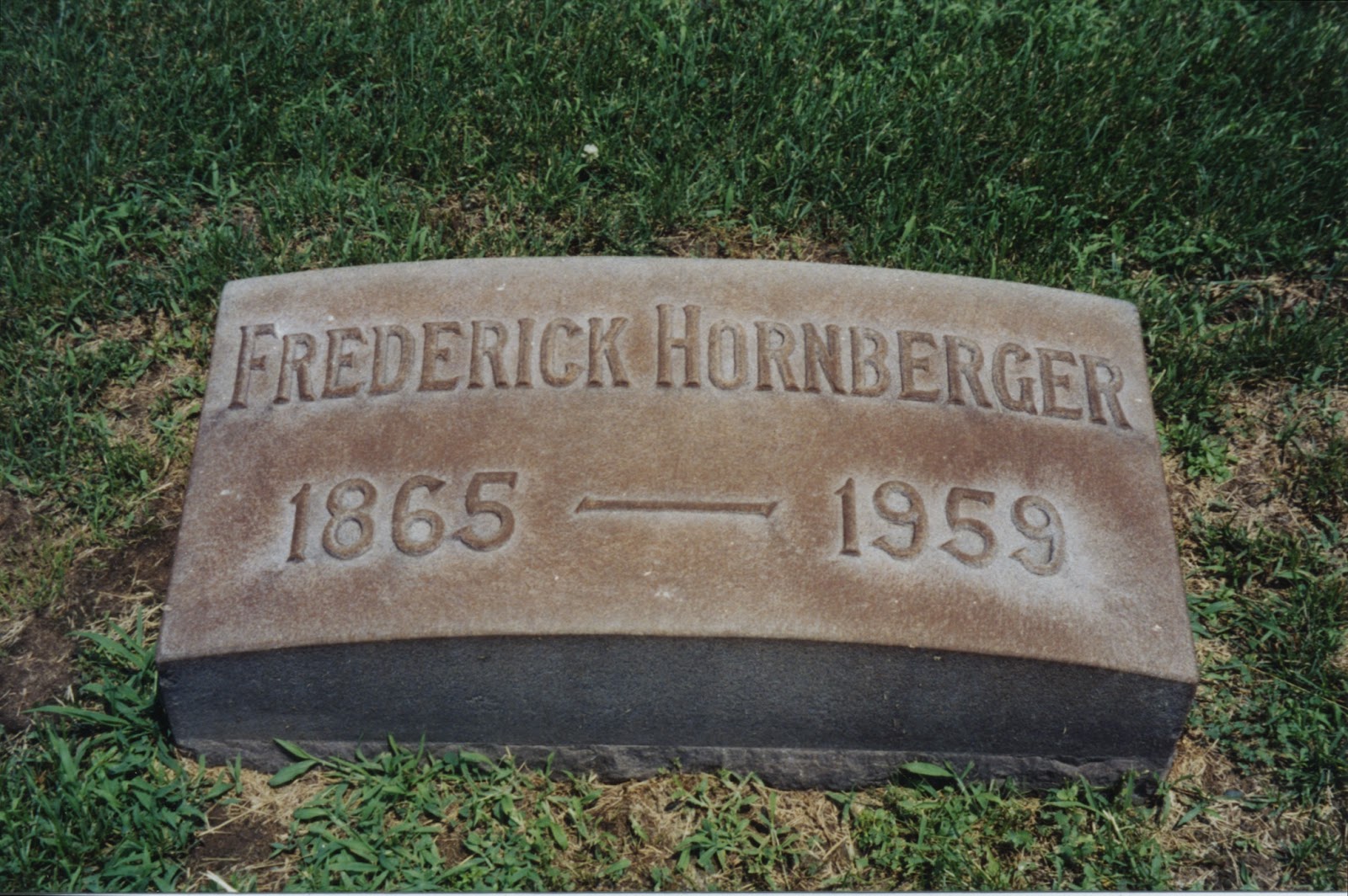
All three of us descend from a man named Frederick Hornberger.  Fred was Nancy and Bob's grandfather and my great-grandfather making us first cousins once removed.  Fred was born 22 Aug 1865 in Alsace Lorraine, France.  Remember that Alsace Lorraine is a region that is sometimes a part of France and sometimes a part of Germany, so one needs to look at the date of the evnet to identify the right country when the event happened.  Fred was a barber for much of his life in Ironton, Ohio.  He died 16 Nov 1959.  ( an area of NE France, comprising the modern regions of Alsace andLorraine: under German rule 1871-1919 and 1940-44)

  Frederick Hornberger appeared in open court Nov 2, 1886.  “Frederick Hornberger, an alien, who being duly sworn, says that he is a native of Germany and came to the United States on or about the day of July 1880, under the age of eighteen years; that he is twenty one years of age and upwards; that it boni fide his intention to become a citizen of the United States and to renounce forever all allegiance ....to the Emperor of Germany whose subject he is....”....”Also at the same time, personally appeared in open court Michael Scherror who resides at Ironton, Ohio and Jacob Scherror who resides at Ironton, Ohio and being duly sworn, sat that they are citizens of the United States and are acquainted with Frederick Hornberger an applicant for naturalization and know that he has been in the United States for five years last,....”  attached to this paper is a certificate of Naturalization of minors.  and Naturalization dated the 17th day of April 1928 from the probate court of Ironton, Ohio.81-ctx-.tiff
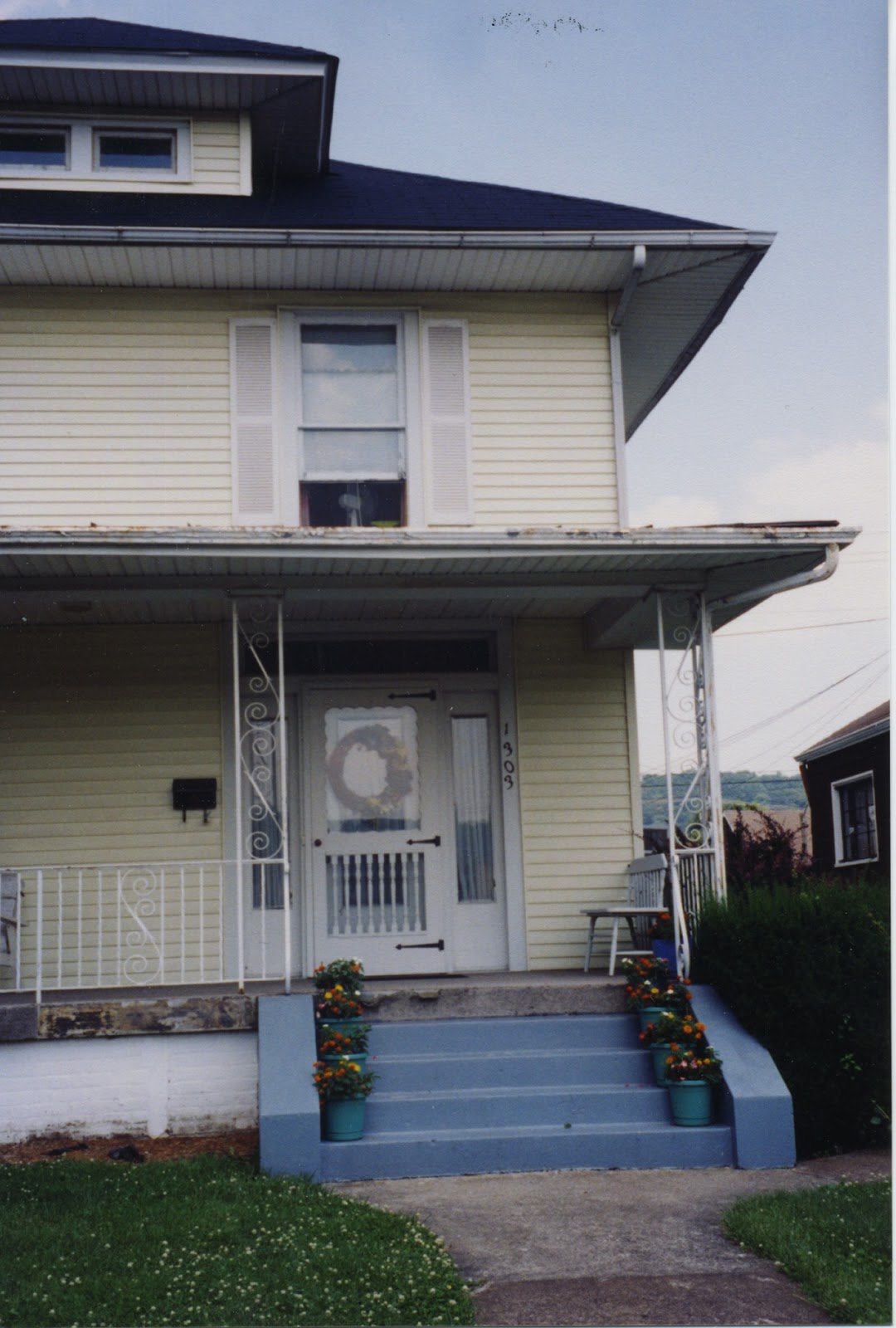
   The home in which Grandmother was raised by Frederick Hornberger is at the corner of 5th St and Spruce.  The address in Ironton is 1303 South 5th St.  Later when just Frederick and Emma were left, they rented or sold the big house and  lived in the little house behind the big house at that address. 


I think it very likely that this is indeed the door that is in the photo of the young woman that I was trying to identify.  I feel very certain that it is my grandmother, Clara Margaret Hornberger Sammons.
and the below is likely the smalll house that Fred and Emma lived in when all of the other children were gone.
These house photos were taken by me in 1997.

Frederick Hornberger is buried with both wives in the Woodland Cemetery in Ironton. 


  Lawrence R. died at birth and Maggie died in childbirth..  Lawrence R. and Maggie are buried side by side along with Frederick Hornberger and Anna Hornberger (Frederick’s second wife).  Close by is Emma Hornberger (grandmother’s older unmarried sister who lived with their father until his death.)  Also buried there is William F. Gravenkemper, a baby of Aunt Frieda’s.  Close by in Platt A is Eleanor Haney and her husband, David--She was also a daughter of Frederick Hornberger.  She is buried among many Haneys.

 In the cemtery in Ironton. there is a small monument with Lawrence Schmidtt’s name on it.  Then there are headstones for Lawrence, his wife Margaret, and her father, Abraham Rauch all together.


Frederick  Hornberger's parents were George and Barbara Schweikart Hornberger.   I was told that Frederick’s father died when Frederick was fairly young.  He had fought under Napoleon.  Barbara married a Mr. Unger after the death of Frederick and they came directly to Ironton because they had relatives there--the Schweickart’s who were in the lumber business.  They moved when Frederick was about 16.  Frederick had one sister that I know about who was named Lena.  I was told that Lena lived and died in Coal Grove.

The Children of Frederick and Maggie Schmidt Hornberger were:  Emma b. Feb 1889, Clara Margaret b. 5 May 1890, George b. Jan 1892,  Frieda b. 26 July 1895, Eleanor b. 1897, Carl b. Feb 1899, Lawrence who died at birth in 1901. From

Margaret Schmidt Hornberger's parents were Lawrence Schmidt and Margaret Rauch.  Lawrence was born 10 August 1824 and died 9 Jan 1883.  Clara Hornberger Sammons (my grandmother told me that they lived on a farm in Hanging Rock.  She would point out the church on the side of the road and say that they had attended church in that building when we would drive by Hanging Rock on our way to or from Ironton and Huntington.


  On June 30, 1997 I visited the genealogy section of the ironton Library on 5th ST.  I was unable to find lawrence or any of his family in the 1870 census for lawrence County.  However in the 1880 census for Hamilton Township in Lawrence County (which is where Hanging Rock is located) I found Lawrence as head of his family on p122c.  I made a copy of this record.  Living with Lawrence who is 57 at the time is Margarete, his wife, who is 45, Emma who is 19, Loucinda who is 14, Albert who is 13, Margarete who is 13, and Kate who is 10.  Also Abraham Rauch who is his father-in-law who is 82 and Frank Kassick, a boarder who is 23 and a farm laborer.  So Lawrence must have moved his family to Lawrence County and specifically to Hanging Rock sometime after 1870 but before 1880.  Both Lawrence and his wife list their place of birth as France and list both sets of their repective parents as also having been born in France.  All of their children were born in Ohio.  So the puzzle is: If there 19 year old was born in Ohio, they must have come across the ocean before her birth.  That means that they immigrated before 1861.  I need to check censuses in other areas of Ohio for 1860 and 1870 to see if I can find them.  I might also look at land records to see when Lawrence bought the farm at Hanging Rock--probably between 1870 and 1880.  It is also possible that I missed the census record back in 1997...now it is much easier to check censuses.....I should take care of this....

From the family information that Nancy and Bob's sister had gathered while in High School comes the following:  Abraham was born 1798 in Strasbourg, France.  Died 1885  Abraham was the father of Margaret Rauch Schmitt Note the spelling of Schmitt in an older transcription.  I should drive to Ironton to see how it is spelled on the tombstone and also see if there is a death certificate with the spelling on it... Bob had asked me what the correct spelling is.  


In the above map one can see where Strasbourg was located.  Jack and I visited there many years ago.  I would like to add some photos of the area.  We were driving and it was very interesting to see that Hornberger was a VERY common name in the area.  We visited Strasbourg and I have photos that I would like to add here.  I did not have the information that Lawrence Schmitt was born in Strasbourg when we made our visit.  

One more comment before I quit for the night.  My mtDNA results show me to be:  Haplogroup H.  According to Brian Sykes in his book the Seven Daughter's of Eve, this group has origins in the white area shown on the map below that is marked Helena:  

As you can see, the area is absolutely right for my maternal lines...very close to where my mother's mother's family lived as late as the 1800s.  My "clan mother"  lived 20,000 years ago when the ice age was at it's most severe.  These were the people who had pictures of "the hunt" on cave walls. Brian Sykes has nicknamed the clan mother for Haplogroup H Helena.   As an additional aside from Brian Sykes' book:

"Over successive generations the clan that began with Helena became easily the most successful in Europe, reaching every part of the continent.  The reference sequence with which all mitochondrial mutations are compared is that of Helena's sequence.  Forty-seven per cent of modern Europeans are members of her clan.  We do not know whether this remarkable success is because her mitochondrial DNA possesses some special quality that gives its holders a biological advantage, or whether it is just chance that makes so many Europeans trace their direct maternal ancestry back to Helena and the freezing winters of her Ice-Age."  (taken from p. 233)

In 2018 I am adding the following:

I have a quiet day today.  So I picked up a couple of magazines to figure out if they need to be passed on to someone.  The first is the NGS Magazine from October-December 2017.  There is an article about mtDNA by Diahan Southard.  I have copied the article and put it in a folder labelled mtDNA in the DNA cubby in my office.